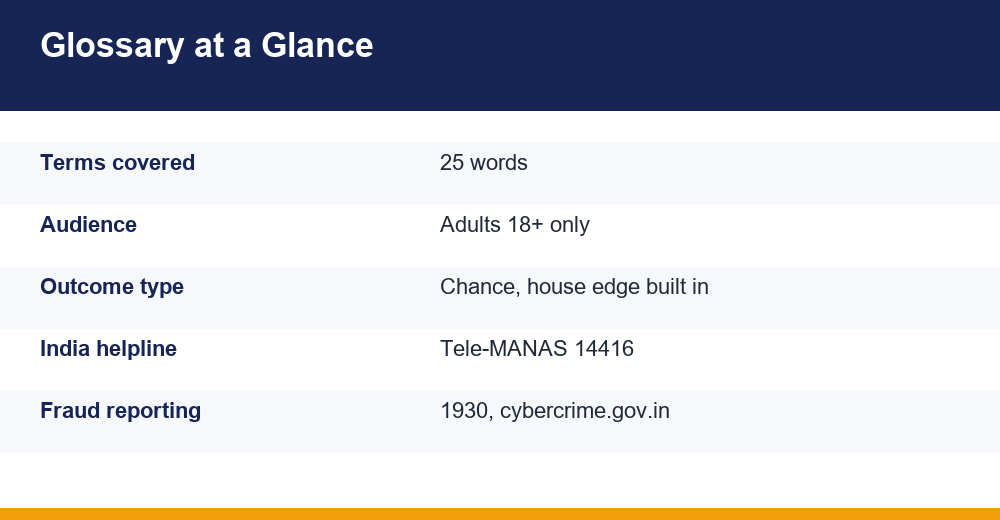
Most people meet colour prediction game terms for the first time inside an app screen or a forwarded group message, where nobody stops to define anything. This page does the opposite: it is a neutral glossary of the 25 words you actually see on screen, written for adults 18+ who want to understand the vocabulary rather than be sold on it. Nothing here encourages play, because these are timed games of chance with a built-in house edge and real money at risk.
Colour Prediction Game Terms Explained in Plain English
A glossary earns its place here because the vocabulary is deliberately soft. A period number sounds like neutral scheduling language. The word prediction suggests skill, foresight or analysis, when the underlying outcome is simply a random draw. Once you know what each label on the screen actually refers to, promotional material becomes much easier to read critically.
The colour prediction game terms below are grouped the way they appear in a typical app: timing first, then the selections you can make, then the money labels, then the marketing language layered on top. If the whole format is new to you, our overview of what a colour prediction game is sets the scene, and you can treat this page as the reference you return to.
Two things are worth stating before the definitions start. First, every term described here is a user-interface label, not a mechanism you can influence. Second, definitions differ slightly between apps, so the wording in a platform’s own rules section always overrides a general glossary.
- Skim the quick reference table if you only need one word defined.
- Read the timing section if you are confused about when a selection locks.
- Read the money section before you believe any figure shown as a “balance”.
- Treat payout multipliers as platform-specific, never as fixed industry values.
Round and Timing Words: Period, Window and Result
A round is one complete cycle: the clock opens, selections are accepted, selections lock, and a result is published. Almost everything on the main screen is a label attached to some part of that cycle.
What is a period number in colour prediction games?
A period number is the unique identifier given to a single round. It exists so that every published result can be matched to exactly one cycle, the way an invoice number identifies one transaction. On most apps the string is long and looks machine-generated, often combining a date with a sequence counter for that day, and it appears beside each entry in the results history.
The period number is a reference tag, nothing more. It does not encode the outcome, and it cannot be decoded. Community posts that claim the digits inside a period number hint at the next result are describing a folk theory, not a documented feature. Each round is generated independently of the last, which is the whole point of a random draw.
What is a betting window?
The betting window is the portion of a round during which selections are still accepted. When the countdown reaches its cut-off, the window closes and the interface stops taking input, usually a few seconds before the result appears. Anything you tap after the close belongs to the next period, which is a common source of confusion and of complaints about “wrong round” placements.
The result or draw is the published outcome for that period: a digit, a colour, and a size category. Results are typically listed in a scrolling history table. If you want the mechanics behind that step rather than the label, see our explainer on how colour prediction results work.
- Round lengths vary by app. Thirty seconds, one minute, three minutes, five minutes and ten minutes are all used, so treat any single figure as illustrative.
- Shorter rounds mean more decisions per hour, which is why time-based limits matter more than they first appear.
- A visible countdown is a design choice, not a guarantee that your device clock and the server clock agree.
Wingo and Other Format Names You Will See
What is a wingo game?
Wingo is a product name used across many colour prediction apps for the standard timed-draw format: a short countdown, a selection of colour, size or exact digit, and a published result at the end of each period. The name is usually followed by the round length, so Wingo 1 Min or Wingo 3 Min simply means the same format on a different clock.
There is no single owner or standard behind the word. Different operators use it for near-identical screens, and some use entirely different branding for the same mechanic. Treat Wingo as a format label rather than a specific game with fixed rules, and read the rules panel on whatever screen you are looking at.
You will also meet names borrowed from trading and lottery vocabulary. “Colour trading” is one of them, and it is worth noticing how much that phrasing does: trading implies research, markets and skill, while the mechanic underneath remains a timed chance outcome with a margin held by the operator.
- Format names describe the timer and the selection types, not the fairness of the draw.
- Identical screens under different names are common, because many apps run similar back-end software.
- A long results history on screen proves only that results were recorded, not that they were independently audited.
Colour Words: Red, Green and the Role of Violet
Red and green are the two main colour categories, each mapped to a set of digits in the 0 to 9 range. The mapping is fixed by the platform and shown in its rules panel. Nothing about the colour itself matters; it is a visual shorthand for a group of numbers.
What does violet mean in a colour prediction game?
Violet is the third colour category, and on most layouts it is attached to the shared or boundary digits rather than to a block of its own. In the common arrangement, the digits 0 and 5 count as violet as well as belonging to one of the main colours, which is why those two results are often displayed with two colours at once.
Because violet is tied to only a couple of digits, it lands far less often than red or green, and operators attach a higher multiplier to it. That trade-off is the entire design: rarer category, bigger advertised multiplier, same underlying randomness. Reported violet multipliers differ widely between apps, so any number you see quoted elsewhere should be read as illustrative rather than standard.
The shared-digit arrangement also explains a frequent complaint. When a result lands on a boundary digit, a straight colour selection may be settled at a reduced rate rather than the headline rate, because the outcome belongs to two categories simultaneously. The rules panel, not the marketing banner, is where that detail is written down.
Big, Small and Exact Number Selections
What does big and small mean in wingo?
Big and small are size categories that split the digit range in two. The arrangement you will see most often treats 0 to 4 as small and 5 to 9 as big, so instead of naming an exact digit you are naming a half of the range. Some apps describe the split differently, which is one more reason to read the rules panel rather than assume.
A number bet names one exact digit from 0 to 9. It is the narrowest selection on the screen and therefore carries the largest advertised multiplier. Some interfaces also let you combine a colour with a size category in a single placement, which looks like a strategy but is still two chance categories resolved by one random digit.
The word multiplier deserves a caution of its own. A multiplier is a settlement rate, not an expected return. Across any format, the rates attached to narrower categories are set so the operator retains a margin on the whole pool of activity, which is what people mean by a house edge. No arrangement of colour, size and number selections removes that margin.
- Selection types do not interact. Choosing a colour and a size in the same round does not hedge anything in a meaningful sense.
- A longer losing or winning streak in the history table is normal in independent random sequences and is not a signal.
- Advertised multipliers are the operator’s settlement terms and can be changed by the operator.
Money Words: Wallet, Bonus Balance and Turnover
What is a wallet balance versus a bonus balance?
A wallet balance is the amount an app records as your own deposited or settled funds. A bonus balance is promotional credit the operator has added to your account, and it usually sits in a separate line with its own rules. The two look similar on screen but behave very differently when you ask to take money out.
The condition attached to bonus credit is the turnover requirement, sometimes called a wagering or rollover condition. It specifies how much total activity must pass through the account before bonus-linked amounts can be withdrawn. A high requirement can mean promotional credit is effectively locked, which is why a headline bonus figure tells you almost nothing on its own.
Recharge is the app’s word for adding money, and withdrawal for taking it out. Withdrawal screens usually introduce three more terms: minimum withdrawal, processing time, and KYC. KYC stands for know your customer, the identity verification step most platforms require before releasing funds, and unfinished KYC is one of the most common reasons a withdrawal stalls.
Account-side vocabulary shows up at sign-up too, including invitation codes and referral links. Our walkthrough of a typical colour prediction app login process covers where those fields appear and what each one records, without recommending any platform.
- Read bonus terms before treating promotional credit as money you own.
- Note the minimum withdrawal figure early, because it can exceed a small balance.
- Keep your own record of deposits and withdrawals rather than relying on in-app history alone.
- Treat any request for an OTP, PIN or full card number by a person in a chat group as a fraud signal, regardless of what the app shows.
Quick Reference Table of 25 Words
This table collects the colour prediction game terms covered above plus a few that appear in promotional material. Definitions are general, and a platform’s own rules page always takes precedence.
| Term | Where it appears | Plain meaning |
|---|---|---|
| Round | Main screen | One full cycle from open to result |
| Period number | History list | Unique ID for a single round |
| Betting window | Countdown timer | The time selections are accepted |
| Result / draw | History list | The published outcome of a period |
| Wingo | Game tab name | Common name for the timed-draw format |
| Big | Selection buttons | Upper half of the digit range |
| Small | Selection buttons | Lower half of the digit range |
| Red | Selection buttons | One mapped group of digits |
| Green | Selection buttons | The other mapped group of digits |
| Violet | Selection buttons | Third category on shared digits |
| Number bet | Digit grid | A selection naming one exact digit |
| Colour bet | Selection buttons | A selection naming a colour group |
| Stake | Entry field | The amount placed on a selection |
| Multiplier | Button label | Settlement rate for a category |
| Payout | History list | Amount returned after settlement |
| RNG | Rules panel | Random number generator behind results |
| House edge | Rarely shown | Built-in margin retained by the operator |
| Wallet balance | Account screen | Deposited or settled own funds |
| Bonus balance | Account screen | Promotional credit with conditions |
| Turnover requirement | Bonus terms | Activity needed before withdrawal |
| Recharge | Payments screen | Adding money to the account |
| Withdrawal | Payments screen | Requesting money out |
| KYC | Verification screen | Identity check before payouts |
| Invitation code | Sign-up form | Referral tag linking you to a promoter |
| Prediction group | Outside the app | Chat channel selling tips or signals |
Read the table as a decoder, not a checklist of features to try. Twenty-five words cover almost every label on a typical screen, and the ones most worth re-reading are turnover requirement, house edge and prediction group, because those three are where the gap between the wording and the reality is widest.
Misleading Words and Red Flags to Notice
Some of the colour prediction game terms you meet are not interface labels at all. They are marketing language used in chat groups, short videos and cloned apps, and they tend to borrow credibility from finance, technology or officialdom.
The most common is the signal or prediction sold by a group admin, usually framed as analysis of past period numbers. Independent random draws carry no memory, so a published history cannot narrow down the next outcome. Where a channel charges for access to such claims, the paid product is confidence, not information.
- Claims of guaranteed, assured or risk-free outcomes. Chance outcomes cannot carry a guarantee.
- Pressure to recharge within a countdown, or an offer that expires in minutes.
- Screenshots of large balances as proof, which are trivially edited and prove nothing.
- A download link sent by a stranger, or an app file shared outside an official store listing.
- A “support agent” who contacts you first and asks for an OTP, PIN, UPI PIN or card details.
- Requests to transfer money to a personal account rather than through the app’s own payment screen.
- A withdrawal that is blocked until you pay a fee or unlock charge to an individual.
Cloned apps are a related risk. Because format names are generic, a copycat app can reuse a familiar name, logo and layout while routing deposits elsewhere. Unusual permission requests, a mismatched developer name, or a listing with almost no history are all worth stopping for.
If money has already left your account through a fraudulent app, group or fake agent, the cyber fraud reporting route in India is the helpline 1930 and the National Cyber Crime Reporting Portal at cybercrime.gov.in. Reporting quickly matters, because tracing requests work better on recent transactions. No named platform is being called fraudulent here; the point is to recognise the pattern and judge for yourself.
Staying in Control and Finding Help
Understanding colour prediction game terms is useful mainly as a defence. Knowing that a betting window is seconds long, that a bonus balance is conditional, and that a period number encodes nothing, removes most of the mystique that promotional content relies on.
Short rounds compress decisions. A one-minute format allows dozens of placements in an hour, and the phrase people use afterwards is almost always “chasing” rather than “deciding”. Deposit limits, session reminders and simple written limits set in advance work better than intentions formed mid-session, and these games are for adults 18+ only.
- Decide a fixed amount before opening the app, and treat it as spent rather than invested.
- Set a clock-based stop, not an outcome-based one, because an outcome-based stop moves.
- Keep payment credentials off shared devices and out of chat groups entirely.
- Step away from any group whose tone turns to urgency, secrecy or shame.
If any of this is affecting sleep, money, work or relationships, support exists and asking for it early is ordinary. In India, the government’s Tele-MANAS mental health helpline is reachable free on 14416, around the clock, with details and language options published by the Ministry of Health and Family Welfare at telemanas.mohfw.gov.in.
Treat this glossary as a dictionary rather than an invitation. Timed colour draws are chance events with a margin built in for the operator, real money is at stake, and the clearest benefit of learning the vocabulary is being able to read what an app and its promoters are actually telling you.
Frequently Asked Questions
What is a period number in colour prediction games?
A period number is the unique identifier attached to one round, so each published result can be matched to exactly one cycle. It usually combines a date with a daily sequence counter and appears beside every entry in the results history. It is only a reference tag: it does not encode or reveal the outcome, and it cannot be decoded.
What does big and small mean in wingo?
They are size categories splitting the digit range in half. The arrangement you see most often counts 0 to 4 as small and 5 to 9 as big, so you are naming a half of the range rather than one exact digit. Some apps define the split differently, so the platform’s own rules panel is the authority.
What does violet mean in a colour prediction game?
Violet is the third colour category, usually attached to shared boundary digits such as 0 and 5 rather than a block of its own. That makes it far less frequent than red or green, so operators attach a higher settlement multiplier. Quoted violet multipliers vary widely between apps and should be read as illustrative only.
What is a wallet balance versus a bonus balance?
A wallet balance is what the app records as your own deposited or settled funds. A bonus balance is promotional credit added by the operator and governed by separate conditions, typically a turnover requirement stating how much activity must pass through the account first. The two look alike on screen but behave very differently at withdrawal.