Colour prediction game scams follow a script so consistent that once you see it written out, you can usually work out which stage you are standing in. This breakdown walks through the pattern from the first invite link to the final “unlock fee”, explains why the early wins feel so convincing, and sets out what to save and where to report if money has already left your account. Outcomes in these apps are chance-based with a built-in house edge, real money is at risk, and everything below is written for adults aged 18 and over.
What These Apps Really Are Underneath
Strip away the trading-style charts and the countdown timer and the mechanic is simple: you stake money on a colour or a number, a result appears, and you either lose the stake or receive a multiple of it. The result is produced on the operator’s own server. You are not reading a market, you are waiting for a number you have no sight of and no influence over.
That single fact matters more than any other detail on this page. Because the outcome is server-generated, there is no pattern to study, no chart that carries information, and no sequence that becomes “due”. The interface is built to look analytical precisely because analysis feels safer than a coin toss. If you want the mechanics in plain terms before going further, start with how a colour prediction round is actually structured.
It is worth being blunt about the arithmetic too. Every product of this kind pays out less than it takes in across all players, because the gap between the true chance of a result and the multiple offered on it is the operator’s margin. That margin does not switch off on a good day or for a careful player. It is the reason the balance drifts downwards over enough rounds, whatever happens in any single one.
There is a second layer, and it is where colour prediction game scams separate from ordinary high-risk play. A straightforward chance product still pays out when you ask for your balance. A fraudulent one is built around the opposite outcome: the deposit rail works smoothly, and the withdrawal rail is a wall with a doorman who keeps naming a new fee.
So the honest question is not “can I beat the colours?” The answer to that is no, by design. The useful question is “is the money I can see on this screen money I can ever move?” Most of the warning signs below are really just different ways of testing that one thing, and they cost nothing to apply.
How Colour Prediction Game Scams Actually Work
Security researchers and Indian newsroom investigations describe a repeatable lifecycle rather than a scatter of unrelated frauds. CloudSEK, which analysed this category after flagging it through its own monitoring, reported identifying around sixty such websites together with hundreds of social media handles promoting them, pushed through layered referral networks. The stages below are the common shape reported across those accounts.
Reading it as a sequence is the point. People rarely recognise a scam from a single red flag, because each individual step looks reasonable on its own. They recognise it when they see that step four is always followed by step five.
| Stage | What you experience | What it is doing |
|---|---|---|
| 1. Contact | An invite link, a referral code, a sudden group add | Bypasses app stores and ordinary search |
| 2. Onboarding | A friendly “mentor” explains the levels and timings | Builds a relationship before any loss |
| 3. Small deposit | A low minimum, instant credit, quick small wins | Proves the deposit rail works |
| 4. First withdrawal | A small payout actually arrives | Manufactures trust in the payout rail |
| 5. Escalation | Bigger stakes, VIP tiers, group screenshots of profits | Moves you past the amount you can afford |
| 6. The wall | A large withdrawal is pending, failed or “under review” | Captures the balance |
| 7. The fee | A processing, tax, unlock or activation charge | Extracts a second payment |
| 8. Exit | Account frozen, handle inactive, group deleted | Ends contact before any refund |
Two rows in that table do the heavy lifting. Stage four is the one almost nobody expects: a genuine small payout is cheap for the operator and buys enormous credibility. Stage seven is the one that confirms everything, because a real payout process never asks you to send money in order to receive money.
The distribution side has its own pattern. These platforms often arrive as a direct download rather than through an app store, which removes the review layer and the easy uninstall trail. If you were sent a file instead of a store listing, read up on what sideloaded betting APK files can do once installed before you tap anything.
Nine Warning Signs: A Checklist
None of these nine items proves wrongdoing on its own, and no named platform is accused of anything here. Treat them as a risk score: one or two is a reason to slow down, four or more and you should stop depositing and test a withdrawal immediately.
- You arrived by invitation, not by searching. A referral link, a WhatsApp forward or a Telegram group add is the single most common entry point into colour prediction game scams.
- You were told to download a file directly, with instructions to allow installation from unknown sources.
- A named individual appoints themselves your mentor and messages you privately with timings, levels or “safe” rounds.
- The platform advertises guaranteed returns, fixed daily income or a hit rate it says cannot fail. No chance-based product can honestly promise this, and the promise alone tells you a great deal.
- Referral earnings are presented as a major reason to join, with commission on the deposits made by people you recruit.
- Deposits clear instantly while withdrawals carry vague review periods, manual approval or no stated timeframe at all.
- Support exists only inside a chat app. There is no company name, no verifiable address and no payout policy you can read before depositing.
- The first small withdrawal works, and the pressure to deposit far more arrives immediately afterwards.
- Any request for an upfront payment to release your own balance, under any label whatsoever.
Number nine is the one that ends the discussion. Everything else can be argued about; a demand to pay before you are paid cannot. If you want a broader test you can apply to any app, not only this category, work through the checks that separate a real app listing from a fake one.
Why These Apps Let You Win At First
Early wins are the detail that confuses people most, and they are not an accident or a glitch. When results are generated on the operator’s own server, the operator chooses what the early rounds look like. A new account that wins modestly in its first sessions costs very little and returns something far more valuable than the stake: your belief that the system is fair.
There is a straightforward psychological mechanism underneath it. A win you experienced yourself outranks any warning you have merely read. Once you have personally watched a balance rise and a small payout land in your bank account, every later red flag gets filed as a technical hiccup rather than a signal, because your own evidence says the platform works.
The group adds a second layer. You see screenshots of other members’ profits, and they look like independent confirmation. In reality you have no way to verify a single one of them, and in cases documented by reporters many such screenshots were produced by the operation itself or by recruiters earning commission on your deposits.
- An early win is information about the operator, not about your odds. It tells you the screen can show a profit, nothing more.
- A smooth run of small wins followed by heavy pressure to deposit more is closer to a warning than a reassurance.
- Test the payout rail with the largest amount you are genuinely willing to lose, before you ever send more than that.
- Treat any amount you cannot withdraw on demand as already gone, and decide from there.
Unlock and Verification Fees Explained
The unlock fee is the closing move of the pattern, and it wears a different costume each time. Reported labels include document-processing charges, tax or clearance deposits, account activation fees, VIP upgrade payments, compliance verification and gateway or currency conversion charges. The costume changes; the structure never does.
The structure is always the same: you must send money before you can receive money. That request alone is enough to classify what you are dealing with, which is why it appears last in the checklist above as the item that needs no supporting evidence.
The amounts are usually calculated as a fraction of the balance you can see, which makes them feel rational. Paying a few thousand rupees to release a much larger figure reads as arithmetic rather than as a decision. But the larger figure is a number on a screen controlled by the person asking for the fee, and in documented colour prediction game scams the balance was never paid out regardless of how many fees were cleared.
It also rarely stops at one. Reports describe a second charge appearing after the first is paid, then a third, each presented as the last remaining obstacle. The clean rule is simple and worth holding on to even mid-conversation: if releasing your own money requires a payment, the payment is the fraud, and stopping at that moment limits the loss to what you have already lost.
Why Big Withdrawals Suddenly Get Blocked
Small payouts are an advertising cost. Large payouts are the entire business model running in reverse. That asymmetry explains why the wall appears exactly when the amount gets meaningful, and why it so often appears on the very first request that exceeds the small amount you successfully withdrew earlier.
The wall is usually presented as process rather than refusal, which is what makes it effective. A withdrawal sits as pending indefinitely. A status reads “under review” with no completion date. The request fails silently and support explains that a document, a tier or a verification step is outstanding. Nobody says no, so you keep waiting instead of reporting.
- A withdrawal below a certain figure clears, and one above it does not.
- Reasons for the delay change each time you ask, or contradict what you were told before.
- You are advised to keep playing while the review completes, rather than to stop.
- Your account is restricted or frozen shortly after you query the delay firmly.
- The payment handle, UPI ID or account details you deposited to stop working or change.
Treat the first blocked withdrawal as the moment to act, not the moment to cooperate. Stop depositing entirely, stop paying anything described as a fee, capture your evidence while you still have access to the account, and move to the reporting steps further down. The window in which money can sometimes be traced or held is measured in hours, not weeks, so speed matters more than certainty at this stage.
Mentors, Groups and Manufactured Pressure
The social layer is doing as much work as the app. A mentor who messages you daily, remembers your name and congratulates your wins creates an obligation that a bare interface never could. Withdrawing from the platform starts to feel like letting a person down, and that feeling is engineered rather than incidental.
Group chats supply the rest. A steady stream of profit screenshots establishes that everyone else is succeeding, which reframes your own doubt as a personal failing rather than a reasonable reaction. Where referral commission is paid on deposits, some of the most enthusiastic voices in that group have a direct financial stake in your next transfer, whether or not they understand what they are part of.
Three pressure tactics recur often enough to name. First, time limits: a bonus round, a tier upgrade or a mentor slot that expires today. Second, loss recovery: a larger deposit framed as the way to win back what you just lost. Third, selective visibility: wins are posted and celebrated while losses are quietly removed or never mentioned, so the group’s apparent track record is filtered rather than real.
A useful counter-move is to make every decision outside the chat. Leave the group, wait a day, and re-read the request in writing with nobody waiting on your reply. Most of the urgency in colour prediction game scams survives only inside the conversation that created it, and almost none of it survives twenty-four hours of silence.
What Evidence to Save Straight Away
Evidence disappears fast in these cases. Groups get deleted, accounts get frozen, apps vanish from the device and payment handles go inactive. Capture everything before you confront anyone, before you uninstall and before you ask for a refund, because any of those actions can trigger the cleanup.
- Transaction records: every deposit and withdrawal attempt with date, time, amount and the transaction ID or UTR number from your bank or UPI app.
- The recipient details you paid to, including UPI IDs, account numbers, wallet handles and any merchant or beneficiary name shown.
- Full screenshots of the platform wallet, the pending or failed withdrawal screen and any error or status message.
- The complete chat history with mentors, recruiters, support agents and the group, exported where the app allows it rather than screenshotted selectively.
- The original invite link, referral code, website address, app name and the download source or file name.
- Any message demanding a fee, tax, unlock charge or verification payment, kept in full with sender details visible.
Store copies somewhere off the device, such as an email to yourself or cloud storage, and keep the originals rather than cropped versions. Complaint forms ask for specific identifiers, and a readable bank statement entry is worth more than a dozen partial screenshots.
One safety rule applies throughout: an OTP, UPI PIN or banking password is never part of a refund, a verification step or any legitimate recovery process. Anyone asking for one, including someone claiming to help you recover an earlier loss, is attempting a second fraud on top of the first.
Reporting a Loss and Finding Support
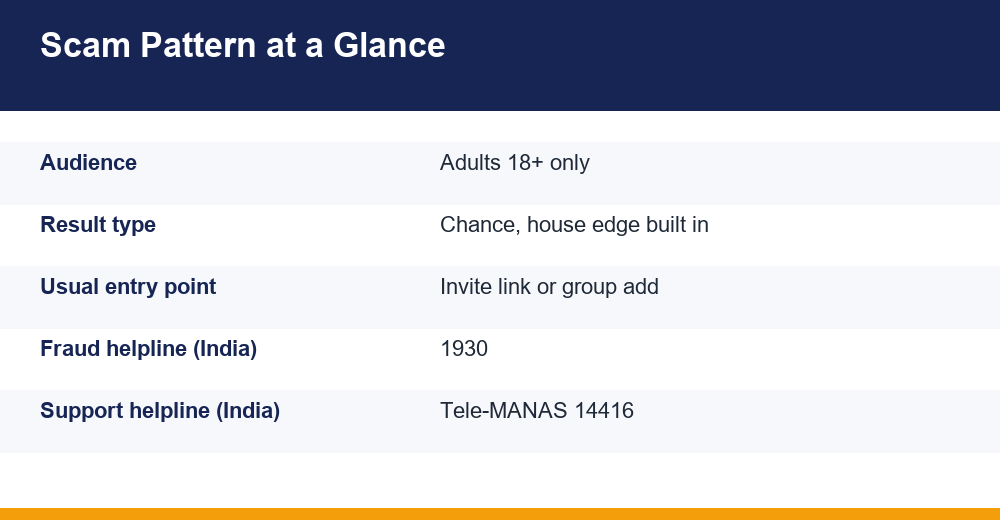
In India, online financial fraud is reported through the national cybercrime helpline on 1930 and the National Cyber Crime Reporting Portal, which is the government’s single channel for filing and tracking a written complaint: cybercrime.gov.in. Official guidance treats the two as one process — call the helpline as soon as you notice the loss, then complete the written complaint on the portal.
Have the specifics ready before you call. A financial-fraud complaint asks which bank, wallet or payment service was involved, the transaction ID or UTR number, the date and the amount, along with your evidence files. Portal registration creates a login using your mobile number and a one-time password, so it helps to draft the account of what happened in advance rather than composing it in the form.
Contact your bank or payment provider in parallel and report the transactions as fraudulent. Reporting quickly is what gives a bank or an intermediary any chance of holding funds that have not yet moved on, which is why the first hours after a blocked withdrawal matter so much more than the following weeks.
Then there is the part people skip. Losses of this kind land with shame attached, and shame is exactly what keeps someone paying one more fee instead of telling anyone. If the money or the playing has stopped feeling controllable, Tele-MANAS on 14416 is India’s free, round-the-clock mental health support line, available in multiple languages. Readers elsewhere can reach BeGambleAware or GamCare in the UK and the National Council on Problem Gambling in the US.
Two closing points worth keeping. Recovery agents who contact you after a loss, promising to retrieve your funds for an advance payment, are a well-documented follow-on fraud that targets exactly the people most desperate to believe them. And colour prediction game scams work on careful, intelligent adults every day, because they are built around trust mechanics rather than technical trickery. Recognising which stage you are in is not a test of intelligence. It is information, and acting on it early is the only part that is within anyone’s control.
Frequently Asked Questions
How do colour prediction scams actually work?
They run as a sequence rather than a single trick. An invite link brings you in, a mentor builds rapport, a small deposit produces quick wins, and a small withdrawal genuinely clears. Stakes then escalate, a large withdrawal is blocked as pending or under review, and a fee is demanded to release it. Contact usually ends after that payment.
Why do colour prediction apps let you win at first?
Because results are generated on the operator’s own server, early outcomes are theirs to choose. A small win and a small successful payout cost very little and buy something valuable: your personal experience that the platform pays. After that, later warning signs get dismissed as technical glitches, because your own evidence seems to contradict them.
What is an unlock fee or verification fee scam?
It is a demand for payment before your balance is released, labelled as document processing, tax clearance, account activation, a VIP upgrade or gateway charges. The label changes but the structure never does: you must send money to receive money. No genuine payout process works that way, and reports describe further fees appearing after the first is paid.
How do I report a colour prediction scam?
In India, call the national cybercrime helpline on 1930 first, then file the written complaint on the National Cyber Crime Reporting Portal at cybercrime.gov.in, as official guidance treats these as one process. Report the transactions to your bank at the same time. Have transaction IDs, dates, amounts, recipient details and screenshots ready before you start.