If you want to know how colour prediction results work, the honest answer is shorter and far less flattering than most pages online suggest: software picks a number, and that number is mapped to a colour. There is no hidden chart, no leaked server pattern, and no analysis method that turns a chance outcome into reliable income. This breakdown explains the actual mechanism, the mathematics of independence, and why the popular “hack” and “blockchain-verified” claims fall apart under a second look.
How Colour Prediction Results Work in Plain Terms
Every round in a colour-based round game follows the same short loop. The app opens a betting window, closes it at a fixed moment, asks a random number generator for a value, and then maps that value onto one of the available colours or numbers. Stakes are settled against a payout table the operator fixed long before anyone placed anything.
So when people ask how colour prediction results work, the technical answer is this: a number is generated, then translated into a label. The colour carries no meaning of its own. It is a name attached to a slice of a probability distribution, much as red and black are names attached to roulette pockets.
- A round timer opens and stakes are accepted for a fixed number of seconds.
- The window closes and no further entries are taken for that round.
- The server requests a value from its number generator.
- That value is matched against an internal result table to produce a colour or digit.
- The result is displayed and balances are adjusted using the pre-set payout multipliers.
Two parts of that sequence sit entirely inside the operator software: the generator and the result table. A player sees only step five. That gap between what happens and what is visible is why almost every misleading claim on this topic exists.
Nothing about this mechanism is exotic. It is the same arrangement used by dice simulations and card shufflers. What differs between products is the payout table, the round length and the house margin baked into the multipliers.
What Is an RNG in Online Games?
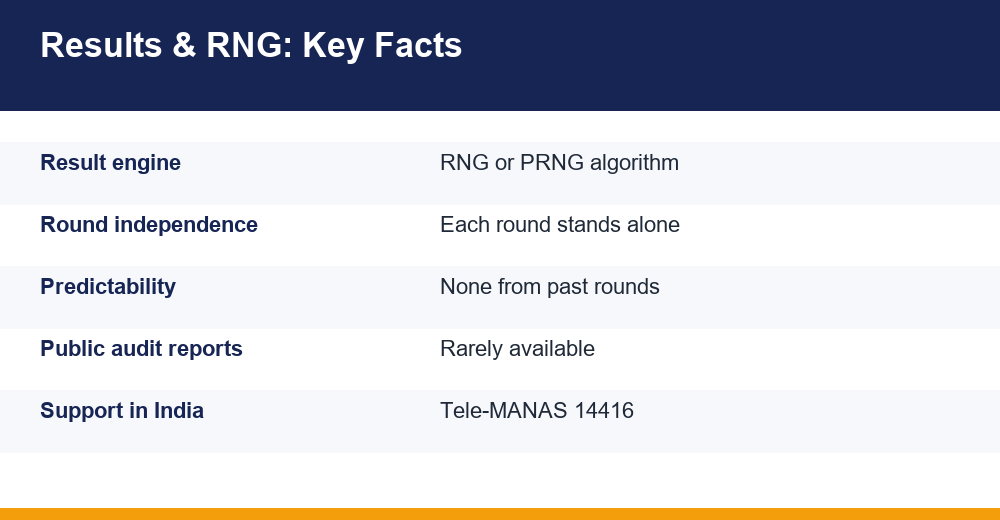
An RNG, or random number generator, is the component that produces the unpredictable value a game needs. Almost all online games use a pseudo-random number generator (PRNG) rather than a physical source. A PRNG is deterministic: feed it the same seed and it produces the same sequence every time.
That sounds like a weakness, and narrowly it is. But the output of a well-built PRNG is statistically indistinguishable from randomness to anyone without the seed: no visible period, no repeating block, no trend a human eye can latch onto.
Pseudo-random versus truly random
- PRNG: an algorithm seeded with a starting value. Reproducible if you know the seed, otherwise unpredictable in practice. The standard choice for software games.
- True RNG: draws entropy from a physical process such as electronic noise or timing jitter. Not reproducible at all, and slower, so it is usually used only to seed a PRNG rather than to run every round.
- Hybrid: a physical source refreshes the seed periodically, while the PRNG generates the per-round values.
The practical point for a player is that none of these three options can be distinguished from the outside. You cannot tell from a results history whether the engine is a certified generator, an unaudited script, or something with the payout distribution quietly tilted. The history looks much the same either way.
If the vocabulary around these products is unfamiliar, it helps to read a plain explanation of the terms used in colour prediction games before taking anyone’s technical claims at face value. A lot of confident-sounding language is used loosely, and “RNG” is one of the worst offenders.
Are Colour Prediction Results Really Random?
Anyone asking how colour prediction results work wants a yes-or-no answer on randomness, and the careful answer has two halves. Within the app design, each round number comes from a generator intended to be unpredictable, so no sequence is readable. But randomness is not independently verified fairness.
A second distinction matters just as much. A result can be perfectly random and still be loaded against you, because the payout multipliers decide the long-run margin. A fair coin paying 1.8x instead of 2x is random and still loses you money.
People regularly mistake clustering for a pattern. Genuine random data is lumpy. Streaks, alternations and long droughts all occur more often than intuition expects, which is why a results board frequently looks like it is “doing something”. Over a very large number of rounds the frequencies flatten out, but no individual run of fifty rounds will look smooth.
Why a results history proves almost nothing
- A short history is far too small a sample to detect a modest bias in the result distribution.
- The history shown in the app is generated by the same system being questioned, so it is not independent evidence.
- Any apparent pattern can be matched by a genuinely random sequence of the same length.
- Changes to a result table could be applied at any time without altering how the history looks.
Can Past Results Predict the Next Colour?
No. Each round is generated separately, so the previous result is not an input to the next one. This is the structural reason every “pattern method” eventually fails, and it is also the reason the belief is so persistent: the human brain is built to find sequences, and a results board is an open invitation to find one.
The error has a name. The gambler’s fallacy is the belief that an outcome becomes “due” after a run of the opposite result. If a colour has not appeared for eight rounds, it is not more likely on the ninth. The generator has no memory of the eight rounds, and nothing in the software is keeping score on your behalf.
An illustrative sum makes the scale clear. On a hypothetical even two-way outcome, the same side appearing eight times running has a probability of about one in 256. A fast-round game can run hundreds of rounds in an evening, so such a streak is ordinary rather than a signal.
The mirror-image error is the hot hand belief, where a run is read as momentum. Both fallacies cannot be right at once, which is a useful tell: whichever one a “method” relies on, it is reading meaning into noise. Why such systems collapse in practice is covered in this look at the reality behind prediction tricks.
Are Colour Prediction Games Rigged? What Can and Cannot Be Verified
This is where honesty matters more than a tidy answer. Nobody outside an operator can inspect its generator, its result table or its server logs, so no one can responsibly declare a specific app either clean or rigged as a matter of fact. What can be said is which checks exist elsewhere in the industry and whether a given product offers them.
Established gaming software is normally tested by independent laboratories that examine generator output and supply certificates. Many small, fast-round colour apps spread through social media publish no testing certificate at all, name no laboratory and identify no owner. That absence is not proof of wrongdoing, but the fairness claim then rests on the operator word alone.
| Claim you will see | What it would actually prove | What it does not prove |
|---|---|---|
| “Results are RNG-based” | A generator produces the value | That the distribution or payouts are fair to you |
| “Provably fair, hash verified” | The committed seed was not swapped mid-round | That the underlying algorithm is unbiased |
| “Blockchain-verified outcomes” | A record exists and is timestamped | That the recorded number came from a fair process |
| “Audited and certified” | Nothing, unless a named lab and certificate exist | Anything at all without a verifiable document |
| “Thousands of happy winners” | Some people posted screenshots | Net outcomes across all participants |
Treat the right-hand column as the working rule. Each of these phrases is doing less work than it appears to do, and all five are commonly used by pages whose actual purpose is to send you through a referral link rather than to inform you.
Judge on documents rather than adjectives. If a product cannot name who operates it, who tested it and where the certificate can be read, you are evaluating a promise.
Do Colour Prediction Hacks Actually Work? Red Flags Checklist
They do not. A “hack” would have to either read the server’s seed or alter the result after the window closes, and neither is something a modified app on your own phone can do. What these files and channels reliably achieve is something else: they extract money, permissions or account access from the person who installs them.
The business model is straightforward once you see it. A paid signal group sends different calls to different subsets of members, then reposts whichever subset was right. Screenshots are cheap to fabricate and trivial to crop. Losses are never posted, so the visible record is pure survivorship bias.
- A sideloaded APK offered outside any official app store, often with a password-protected archive.
- Requests for accessibility permissions, SMS access, or screen recording, none of which a prediction tool would legitimately need.
- A joining fee, “activation charge” or wallet top-up required before any “signal” is shared.
- Claims of a fixed accuracy figure such as 95 per cent, with no verifiable record of calls made in advance.
- Pressure to recruit others, or a commission structure for bringing in members.
- Any request for your OTP, UPI PIN, banking password or remote access to your device.
The last item is the serious one. An OTP or UPI PIN shared with anyone, for any stated reason, hands over control of money. If you have already lost funds to a tool, group or app of this kind in India, financial cyber fraud can be reported on the national helpline 1930 and through the National Cybercrime Reporting Portal at cybercrime.gov.in. Reporting quickly matters, because the chance of freezing a transfer drops sharply with time.
Understanding how colour prediction results work removes the ground these schemes stand on. If the next value is generated independently of everything that came before, there is nothing for a chart, bot or paid signal to read.
What Blockchain-Based Result Generation Means
This phrase usually describes a commit-reveal scheme, marketed as “provably fair”. The cryptography is real, but the marketing stretches it well past what it supports.
In a typical implementation the server generates a secret seed and publishes a cryptographic hash of it before betting opens. The outcome is then derived by combining that seed with a client seed and a round counter. Afterwards the server reveals the seed, so you can re-hash it and recompute the outcome yourself.
- Server creates a secret seed and publishes its hash in advance.
- Your client seed and a round number are combined with that seed.
- A cryptographic hash function turns the combination into the round’s number.
- After the round, the seed is revealed for you to re-hash and compare.
- A match confirms the seed was not changed after your stake was placed.
What the verification does not cover
Verification confirms one specific thing: the seed used was the seed committed to. It says nothing about whether the mapping from number to outcome is balanced, whether the payout multipliers leave a fair margin, or whether the seed itself was chosen from a restricted set. An algorithm that systematically favours certain results can still pass every hash check perfectly.
- It does not make the game profitable, or reduce the operator’s built-in margin.
- It does not audit the result table that converts a number into a colour.
- It only applies to rounds where the seed is genuinely revealed, which some products do inconsistently.
- It is meaningless if nobody actually performs the check, which is the usual situation.
There is also a simpler issue. A verification page hosted by the operator, verifying the operator’s own seeds, with an algorithm the operator wrote, is not independent review. It is self-attestation presented in technical clothing.
House Edge and Real-Money Risk: A Breakdown
Set the randomness question aside for a moment, because the arithmetic of the payout table decides the outcome regardless. These are products for adults aged 18 and over where outcomes are determined by chance, a margin is built into the multipliers, and the money staked is genuinely at risk. That is true whether the generator is immaculate or not.
A simplified illustration shows the shape of it. Suppose an outcome occurs on average once in every two rounds but pays 1.9 times the stake rather than 2. Across many rounds the expected return settles near 95 per cent of the amount staked. These figures are purely illustrative, but the direction never reverses with volume.
| Factor | Who controls it | Can a player influence it? |
|---|---|---|
| Round outcome | Operator’s generator | No |
| Payout multipliers | Operator | No |
| Result-to-colour mapping | Operator | No |
| Stake size | Player | Yes |
| Number of rounds entered | Player | Yes |
| Time spent in the app | Player | Yes |
Notice that everything a player controls is about exposure, not outcome. That is the entire set of levers available, which is a useful corrective to any content suggesting skill, timing or analysis enters into it. For background on the format itself, see this plain explanation of what a colour prediction game actually is.
If chasing losses, borrowing to continue, hiding activity from family, or losing sleep over rounds has become part of the picture, that is a health matter rather than a strategy problem, and free support exists. In India, Tele-MANAS offers a free national mental health helpline on 14416, run by the Ministry of Health and Family Welfare, with details on the official Tele-MANAS website.
Self-Check Before You Believe a Pattern
Most of the misinformation on this topic survives because the questions people ask are too narrow. Once you know how colour prediction results work at the mechanism level, a short set of checks will defuse almost any claim you come across.
- Ask what the previous round contributes to the next one. If the answer is nothing, no pattern method can function.
- Ask who tested the generator, and request the name of the laboratory and the certificate. Vague assurances are not evidence.
- Treat screenshots as unverifiable. Wins are posted, losses are not, so the visible record is systematically skewed.
- Separate “random” from “fair”. A random result with a thin multiplier still carries a margin against you.
- Check what a “provably fair” page actually verifies. Seed integrity is not algorithm fairness.
- Never install a modified APK or grant accessibility, SMS or screen permissions to a prediction tool.
- Never share an OTP, UPI PIN or password, whatever explanation is offered.
- Recognise that the amount staked and the time spent are the only variables you genuinely control.
None of this is complicated, merely unglamorous, which is why pages selling methods rarely say it. A generator produces a number, the number becomes a colour, and the payout table takes its cut.
The most practical takeaway is a change in the question. Instead of asking which colour is next, ask what is actually knowable. Doing so makes the answer obvious: the mechanism is knowable, the margin is knowable, and the next result is not.
Frequently Asked Questions
Are colour prediction results really random?
Within the app’s own design, each round’s value comes from a generator meant to be unpredictable, so no readable sequence exists for players. But randomness is not the same as verified fairness. Outsiders cannot inspect the generator or the result table, and a perfectly random outcome can still carry a payout margin that works against the player over time.
Can past results predict the next colour?
No. Each round is generated independently, so the previous outcome is not an input to the next one. Believing a colour is “due” after a long run is the gambler’s fallacy. The software keeps no score on your behalf, and streaks are an ordinary feature of random data rather than a signal of anything to come.
Do colour prediction hacks actually work?
No. A genuine hack would need to read the server’s secret seed or change a result after the betting window closed, and a modified app on your own phone cannot do either. These files and paid signal groups extract money, permissions or account access instead. Never share an OTP or UPI PIN with anyone promising predictions.
What does blockchain-based result generation mean?
It usually describes a commit-reveal scheme. The server publishes a hash of a secret seed before betting, then reveals the seed afterwards so you can re-hash it and confirm nothing was swapped mid-round. That proves seed integrity only. It does not prove the result-to-colour mapping is balanced or that the payout multipliers are fair.