Betting account kyc verification is the identity check a platform runs before it treats an account as fully yours, and it is the step most people worry about because it means handing over copies of personal documents. Most walkthroughs online tell you which buttons to press, yet few answer the question that matters: what happens to your ID once you upload it. This explainer covers why the check exists, which documents are asked for, how long reviews take, and the privacy precautions worth taking first.
Betting Account KYC Verification Explained in Plain Terms
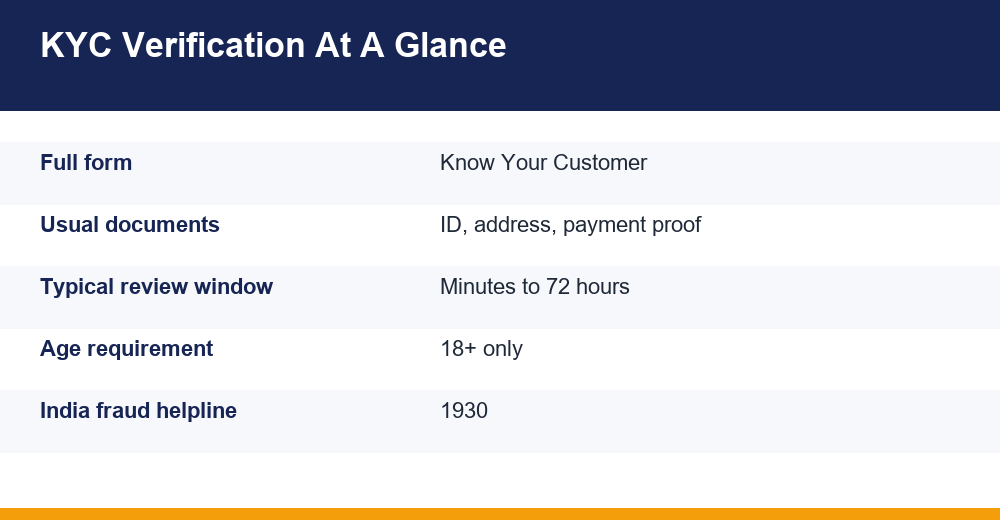
KYC stands for Know Your Customer. It is a general term used across banking, payments, telecom and online platforms for the process of confirming that a customer is a real, identifiable adult person and not a fabricated identity. Betting account kyc verification is simply that same process applied to a gaming or wagering account.
In practice the check has three separate questions behind it. Are you who you say you are? Do you live where you say you live? And is the payment instrument attached to the account genuinely in your name? Different platforms bundle these differently, but almost all of them are trying to answer those three things.
It is worth separating verification from registration. Creating a username takes a minute; verification is a review carried out afterwards by a team or an automated system, and it can sit in a queue. Many people discover the distinction only when a payout is held.
Where the check usually appears
- At signup, before the account can be funded at all
- After a deposit, but before any payout is released
- When a cumulative deposit or withdrawal threshold is crossed
- When the platform’s monitoring flags something unusual about the account
- Periodically, as part of a routine refresh of stored records
Why Betting Sites Ask For KYC Documents
The short answer is that money is involved, and anywhere money moves, identity has to be pinned down. A platform that cannot tell one account holder from another has no reliable way to confirm an adult is using the service or to send a payout to the correct person.
There are four recurring motivations, and understanding them makes the request feel less arbitrary.
- Age assurance. These services are for adults only, 18 and over. A document showing a date of birth is the simplest way to establish that.
- Payout accuracy. If a payout is sent to the wrong account and the money is gone, it is very difficult to reverse. Matching the name on the bank or UPI details to the name on an ID reduces that risk.
- Duplicate account control. Platforms want one account per person. Identity checks are how they detect the same person behind five usernames.
- Fraud and chargeback defence. If a stolen card or hijacked payment handle is used to fund an account, verification gives the platform a trail.
There is also a less-discussed reason: verification protects you against someone else taking over your account and withdrawing to their own details. A verified payout destination is harder for an intruder to change silently. That is one of the few genuine upsides for the account holder, and it works best alongside basic account security hygiene such as unique passwords and two-factor authentication where offered.
What Documents Are Usually Needed
Document lists vary by platform and region, so treat any list you read online as indicative. The pattern is consistent: one proof of identity, one proof of address, and one proof of the payment method. Some documents cover two of those at once.
| Purpose | Commonly accepted | What reviewers look at |
|---|---|---|
| Proof of identity | Passport, driving licence, government photo ID | Clear photo, readable name and date of birth, unexpired |
| Proof of address | Utility bill, bank statement, official correspondence | Recent date, full address visible, name matching the account |
| Proof of payment method | Bank statement header, card image with digits masked, payment app screenshot | Account holder name matches the registered account name |
| Liveness or selfie check | Selfie holding the ID, or a short in-app face scan | Face matches the document photo; document not a screen re-photograph |
A few practical notes on the documents themselves. Reviewers reject blurred corners and cropped edges more often than anything else, so capture the full document on a flat, plain surface in daylight. Avoid flash, which creates glare across holograms and printed text.
Do not alter a document to make it look tidier. Editing software leaves traces, and a file that appears manipulated is far more likely to be refused than a slightly imperfect original.
How Long Verification Takes: Timeline Breakdown
Published timelines differ widely, and many of the numbers circulating online come from affiliate pages rather than platforms. The honest summary: automated checks can clear in minutes, while anything routed to a human reviewer sits in a queue measured in hours or days. Ranges from a few minutes up to 48 or 72 hours appear often in help pages, but those figures are illustrative rather than guaranteed.
Several factors stretch the timeline, and they are mostly predictable.
- Image quality problems that force a resubmission, which restarts the clock
- A name mismatch between the ID, the address proof and the payment method
- Weekend or holiday submissions, when review teams run thin
- Peak periods around major cricket fixtures, when submission volume spikes
- Additional questions triggered by a large or unusual first withdrawal
If a check is pending well beyond the published window, open a support ticket in writing and keep the reference. Delays are also the most common reason people hit problems in the withdrawal process, because an unverified account can accept deposits long before it can release a payout.
One thing not to do: do not open a second account to bypass a stalled review. Duplicate accounts are precisely what identity checks are designed to detect, and the usual outcome is that both accounts are frozen instead of one.
Is It Safe To Upload Your ID?
This is the question operator-specific walkthroughs skip, and it deserves a straight answer: uploading identity documents always carries some risk, and the size of that risk depends almost entirely on who receives them. Unlike a password, you cannot rotate your date of birth or reissue your face, so a stored copy on a poorly secured server is the real exposure.
Signals that a document request is being handled with at least basic care include an upload page served over HTTPS on the platform’s own domain, a stated retention period, a named point of contact for data questions, and an in-app upload rather than a request to email files or send them over a messaging app.
The opposite pattern is the one to walk away from. If documents are requested through WhatsApp, Telegram or a personal email address, the files land on a device and an inbox with no accountability, however official the person sounds.
What you can and cannot control
| Within your control | Not within your control |
|---|---|
| Which platform you hand documents to | How long the platform stores the file |
| Masking non-essential digits before upload | Whether a third-party vendor processes the check |
| Using the in-app upload rather than chat or email | Whether the platform suffers a data breach later |
| Keeping a dated record of what you sent | Who inside the platform can view the file |
Document Privacy Precautions Checklist
These steps cost nothing and meaningfully reduce exposure. Run through them before any betting account kyc verification upload, not after.
- Check the domain before you upload. Type the platform address yourself rather than following a link from a message. Lookalike domains with a changed letter are a standard tactic.
- Mask what is not needed. If the platform only needs to confirm a name and date of birth, cover unrelated numbers with an opaque block, not a blur. Blur can sometimes be reversed.
- Add a visible watermark. Writing the platform name and the date across the image discourages reuse of the same file elsewhere.
- Avoid public Wi-Fi for uploads. Use mobile data or a trusted connection instead.
- Refuse chat-app requests outright. Documents belong in the platform’s own upload form, never in a messaging thread.
- Do not send a full card image. Where a card proof is requested, cover the middle digits and the CVV entirely.
- Clear the gallery afterwards. Delete the photographed copies from your phone’s camera roll and from any cloud backup once the upload is confirmed.
- Never share an OTP, PIN or password. No legitimate verification step requires any of these, and nobody from support needs them.
That last point is the single most exploited gap. Identity checks involve documents, never credentials. Anyone asking for a one-time password while completing your verification is attempting account takeover, and the same logic underpins sensible password security practice.
In India, if documents or money have already been compromised, the national cyber fraud helpline is 1930, and complaints can be filed on the government’s National Cyber Crime Reporting Portal. Reporting quickly matters, because the window for tracing a transfer narrows fast.
Rejections And Repeat Checks: What To Know
A rejected submission is usually mundane. Most refusals come down to legibility or mismatch rather than suspicion. Knowing the common causes lets you fix the problem on the second attempt rather than the fifth.
Why was my verification rejected?
- The image is cut off, out of focus, or glare obscures part of the text
- The document has expired, or the expiry date is not visible
- The name on the ID differs from the registered account name, including initials and spelling variants
- The address proof is older than the accepted window, which is commonly three months
- The payment method is in someone else’s name, such as a family member’s account
- The file is a photo of a screen rather than of the physical document
Name mismatch is the most frequently misunderstood cause. If the account was registered with a shortened name or initials in a different order, correct the account profile first, then resubmit. Changing the document is not an option; changing the profile usually is.
Can a platform ask for documents again later?
Yes, and a repeat request is not by itself a sign of anything wrong. Stored records go stale, addresses change, documents expire, and many platforms refresh their files on a schedule. A second request also commonly follows a change to the registered payment method, which is a reasonable control rather than an obstruction.
What should raise your eyebrow is a repeat request arriving through a different channel from the first, or one that asks for materially more than before, such as a full bank login, a selfie holding a handwritten note with your password, or a screen-sharing session. Those are not verification steps.
Red Flags Around Document Requests
Document harvesting is a known pattern: a site or app collects identity files from people who believe they are completing a routine check, and the documents are used elsewhere. The signals below are warning signs to weigh up yourself, not proof of wrongdoing about any particular platform.
| Red flag | Why it matters |
|---|---|
| App distributed only as a sideloaded file from a link | No store review, no verified publisher, and updates cannot be audited |
| Documents requested over WhatsApp or Telegram | Files land on a personal device with no retention or access controls |
| A fee charged to complete or fast-track verification | Identity checks are an internal cost; a charge to run one is a strong warning sign |
| Any request for an OTP, PIN, password or CVV | These are credentials, never verification evidence |
| No written answer about how long documents are stored | Indicates there may be no retention policy to describe |
| Pressure to upload immediately or lose a balance | Urgency is used to stop people checking the domain and the channel |
Fake applications imitating well-known brands are a recurring problem, and the identity-upload screen is often the whole point of the imitation. Check that the publisher name on a store listing matches the brand, and be sceptical of an app requesting contacts, SMS or gallery permissions it has no functional need for.
If you have already uploaded documents somewhere that now looks wrong, assume the files are out of your hands. Notify your bank, watch statements for unfamiliar activity, and keep the correspondence.
Risk, Chance And Staying In Control
One point sits underneath all of this and is easy to lose sight of while focusing on paperwork. These products are games of chance with a built-in house edge, which means the structure favours the operator over time regardless of how a particular session goes. Real money is at risk, and the service is for adults aged 18 and over only.
No verification step and no amount of account hygiene changes that mathematics. Completing a check makes an account more secure and a payout more likely to reach the right destination; it does not improve any outcome in the game itself.
Completed betting account kyc verification is a sensible moment to set deposit limits, session reminders and loss limits where the platform offers them, precisely because those tools are easiest to switch on before momentum builds rather than during it.
If it stops feeling like a choice
Chasing losses, hiding spending, borrowing to continue, or finding the activity is affecting sleep, work or relationships are all signals worth taking seriously. Support exists and is free. In India, the government’s Tele-MANAS mental health helpline can be reached on 14416, around the clock and in a range of regional languages. For suspected financial fraud, the 1930 helpline is the faster route.
Elsewhere, organisations such as GamCare in the United Kingdom and the National Council on Problem Gambling in the United States run confidential helplines. Reaching out early is easier than reaching out late.
The five facts worth remembering
- Betting account kyc verification confirms identity, address and payment ownership, nothing more
- Clear, unedited, unexpired documents clear reviews fastest
- Timelines range from minutes to a few days; published windows are indicative
- Credentials are never part of a legitimate check, and neither is a verification fee
- Masking, watermarking and in-app uploads reduce exposure at no cost
Frequently Asked Questions
Why do betting sites ask for KYC documents?
Because money is involved. Identity checks let a platform confirm the account holder is an adult, match the payout destination to the right person, prevent one person running several accounts, and build a trail if a stolen card or payment handle is used. They also make it harder for an intruder to redirect a payout from a hijacked account.
What documents are needed for betting KYC?
Typically three things: a photo identity document showing your name and date of birth, a recent proof of address such as a utility bill or statement, and proof that the payment method belongs to you. Some platforms add a selfie or liveness check. Exact lists differ, so check the platform’s own help page rather than a third-party list.
How long does KYC verification take?
Automated checks sometimes clear within minutes, while submissions routed to a human reviewer commonly take hours to a few days. Windows of 24 to 72 hours appear often in help pages, but these are illustrative rather than guaranteed. Blurred images, name mismatches, weekends and peak fixture periods all lengthen the wait.
Is it safe to upload my ID to a betting site?
There is always some risk, because identity data is durable in a way a password is not. Reduce it by uploading only through the platform’s own secure in-app form, never through chat apps or email, masking details that are not required, watermarking the image, and deleting the photographed copies from your phone and cloud backup afterwards.