Self exclusion tools are usually presented as a list of equivalent features, which is misleading. They differ enormously in one respect that decides whether they work at all: how long it takes to undo them. A setting you can reverse in fifteen seconds is a reminder rather than a barrier, and it will be reversed by somebody in a state quite unlike the one they were in when they set it. The six options below are ordered by that criterion rather than by how prominently they are advertised, and the most effective one requires no technology at all.
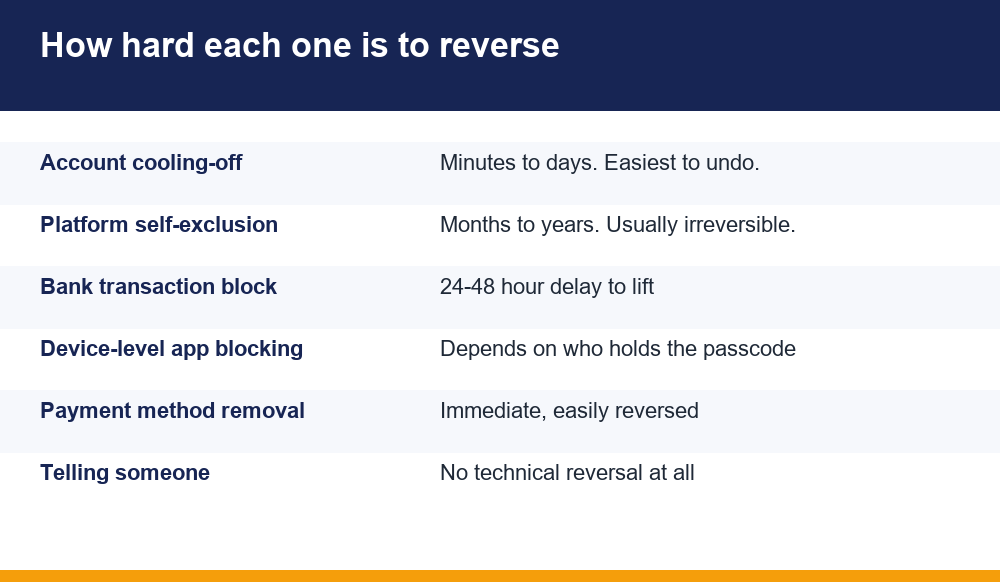
The only principle that matters
The decision to stop and the decision to resume are made by the same person in two very different conditions. One is calm, probably in daylight, thinking about the month. The other is mid-session, behind, and reasoning at speed towards a conclusion already chosen.
Every tool here is an attempt by the first person to constrain the second, and the measure of success is the delay between wanting to resume and being able to. Nothing else about a feature matters nearly as much.
Which produces an unexpected ranking
The tools with the best interfaces tend to be the weakest, because they sit on the platform and the platform benefits from your return. The strongest involve a third party who has no stake in your decision, and the single strongest involves no software at all.
Option one: account cooling-off
A short lock on the account, typically 24 hours to six weeks, available in the responsible play settings of most platforms. It is the gentlest option and genuinely useful for its intended purpose, which is interrupting a bad run rather than stopping altogether.
Its weakness is in the name. A cooling-off period is designed to end, and the account reopens automatically with everything exactly as it was, often accompanied by a welcome-back message and sometimes an offer.
Worth using for what it is. Not worth relying on if the intention is to stop, because it is the only tool here that actively brings you back on a schedule.
Option two: platform self-exclusion
Longer and considerably firmer: typically six months, one year or five, and on a properly run platform it cannot be lifted early no matter how persuasive the request.
That irreversibility is the whole value, and it is the thing to verify before trusting it. A platform that will reinstate an excluded account on request has offered you a cooling-off period with a longer name.
Two further details decide how useful it is. Whether marketing stops, which it should immediately and completely. And whether it covers every brand the operator runs, since many companies operate several sites and excluding from one may leave the others open.
- Ask whether exclusion applies across all brands owned by the operator
- Confirm marketing emails and messages cease, not just account access
- Withdraw any remaining balance before the exclusion begins
- Expect to be asked to confirm more than once; that friction is deliberate
Option three: the bank-level block
Most banks and card issuers now offer a gambling transaction block, applied at the card level. It is the strongest widely available technical control for one structural reason: it sits outside the platform entirely, so no operator can override it and no amount of persuasion inside an app can touch it.
Crucially, most implementations include a mandatory delay of 24 to 48 hours before the block can be lifted, and some require speaking to the bank rather than tapping a switch. That delay is placed exactly where it is needed, between the impulse and the capability.
It is free, it takes a few minutes in a banking app, and of everything on this page it offers the best ratio of effort to protection. If only one item here gets implemented, this is the one worth choosing.
Option four: device and network blocking
Blocking at the device level means app restrictions, content filters or dedicated blocking software; at the network level it means filtering on the home router. Both work, and both have the same vulnerability.
Whoever holds the passcode controls the restriction. If that is you, the barrier is roughly as strong as your resolve in the moment, which is the thing the barrier existed to compensate for. The technique becomes genuinely effective when somebody else sets the passcode and does not share it.
Router-level filtering has a further gap worth naming: it protects the home network and nothing else. A phone on mobile data walks straight past it, which makes it useful as part of a set and unreliable on its own.
Option five: removing the payment rails
The least technical and most underrated category. Remove saved cards from the account, delete the app, log out everywhere, and fund nothing from the account that holds your salary.
None of this prevents anything. What it does is convert a single tap into a sequence of deliberate steps, each one an opportunity to stop. Thirty seconds of friction is worthless in a calm moment and frequently decisive in the moment that matters.
The strongest version is structural: keep funding in a separate account, topped up on a schedule decided in advance. The balance becomes a ceiling that enforces itself, with no settings to maintain and nothing for anybody to reverse.
We went through the account-side mechanics of this, including what each deposit method leaves behind, in our notes on the terms these platforms actually operate under.
Option six: the one with no off switch
Every tool above shares a weakness that is easy to miss because it is not technical: they are all private. The only person who sees a limit being dismantled is the person dismantling it, and that person has already decided.
Telling somebody changes the arithmetic. It does not require a difficult conversation or a confession, and it does not mean handing over control. Saying to a partner or a friend that you have set a particular figure, and that you will mention it if it changes, is enough to add a cost that no setting can.
Where things have gone further than a question of discipline, the same principle scales. Free and confidential support services exist in most countries, the first conversation is usually practical rather than heavy, and reaching one early is markedly easier than reaching one late. Nothing on this page is a substitute for that where it is needed.
The gaps self exclusion tools leave
Honesty about the limitations matters, because a tool trusted beyond its actual coverage is worse than one used with clear eyes.
| Tool | What it does not cover |
|---|---|
| Platform exclusion | Every other platform, and often sister brands |
| Bank card block | Bank transfers, wallets, and payments through intermediaries |
| Device blocking | Other devices, and anyone who knows the passcode |
| Router filtering | Mobile data, and any network outside the home |
| Payment removal | Re-entering the details, which takes a minute |
The pattern is that each covers one route and leaves others open, which argues for using several together rather than choosing the best one. Three overlapping barriers with different reversal delays are considerably stronger than any single tool, because the gaps do not line up.
Choosing between them
A reasonable order for most people, from least to most committing.
- Set the bank-level block. Highest protection for the least effort, and the delay is built in.
- Remove saved payment methods and delete the app from the home screen.
- Move funding to a separate account topped up on a schedule.
- Tell one person the figure you have settled on.
- Use a cooling-off period when a specific session has gone badly.
- Use full platform self-exclusion when the intention is to stop rather than pause.
The sequence matters less than the timing. Set these on an ordinary day when none of it feels urgent, because that is the only moment the decision is being made by somebody with nothing invested in the answer. Controls chosen in reaction to a bad week tend to be either punitive and abandoned within a fortnight, or quietly generous enough to change nothing at all.
What the evidence says about what works
Two patterns come up repeatedly in research on self exclusion tools, and both cut against how the features are usually presented.
The first is that combinations outperform individual measures by a wide margin. Someone with a platform exclusion, a bank block and a person who knows about both is in a materially different position from someone with the strongest single tool, because the gaps in each are covered by the others rather than lining up.
The second is that the moment of setting up matters as much as the choice of tool. Controls configured during or immediately after a bad session are frequently either too severe to live with, and abandoned within weeks, or set at a level that changes nothing. Those chosen on an unremarkable day tend to survive, because the person choosing had no particular outcome they were arguing towards.
- Use several overlapping measures rather than hunting for the single best one
- Set them on an ordinary day, not a bad one
- Write down the reasoning somewhere you will see it later
- Review the whole arrangement twice a year, since features and settings change
One further note on relapse, because it is treated as failure and usually is not. Resuming after an exclusion is common and is better understood as information than as a verdict: it indicates which barrier gave way, and the useful response is to replace that barrier with one carrying a longer delay rather than to conclude that none of it works.
Finally, a word on what self exclusion tools are for. They are not a judgement and they are not an admission. A deposit cap is the same kind of decision as a standing order into savings: a choice made once, by a version of you with the time to think, so that it does not have to be remade every evening under worse conditions. Framed that way, setting them is unremarkable rather than significant, and the unremarkable framing is the one most likely to survive.
If a reader takes one thing from this page, make it the bank block, and make it today rather than at some better moment. It is five minutes, it costs nothing, and self exclusion tools provided by the platform cannot match it for the simple reason that the bank has no interest in your coming back.
Frequently Asked Questions
What is the difference between cooling-off and self-exclusion?
A cooling-off period is short, usually a day to six weeks, and ends automatically with the account reopening as it was. Self-exclusion runs for months or years and should not be reversible early. One is a pause, the other is intended as a stop.
Which self exclusion tool is strongest?
The bank-level transaction block, for most people. It sits outside the platform so no operator can override it, lifting it usually carries a mandatory 24 to 48 hour delay, and it takes only a few minutes to set up in a banking app.
Does excluding from one site cover others?
Not automatically, and often not even across brands owned by the same operator. It is worth asking specifically whether an exclusion applies to every site the company runs, because many operate several under different names.
Can a bank block be bypassed?
There are gaps. Blocks generally apply to card transactions and may not catch bank transfers, wallet top-ups or payments routed through an intermediary. Coverage also varies with how a merchant is categorised, so it is worth testing rather than assuming.
Does app blocking on a phone work?
It works to the extent that somebody else holds the passcode. If you set and can remove the restriction yourself, it provides friction rather than a barrier, which still has value in the moment but should not be relied on alone.