The three cricket betting odds formats you will run into are decimal, fractional and American, and all three describe exactly the same price in different handwriting. Most beginner pages rush past this and start selling an app instead of teaching the reader to read the number. This explainer sticks to the arithmetic: what each format says, how to convert between them, and why the figure on screen never equals the true chance of an outcome.
Cricket Betting Odds Formats Explained: Three Ways To Write One Price
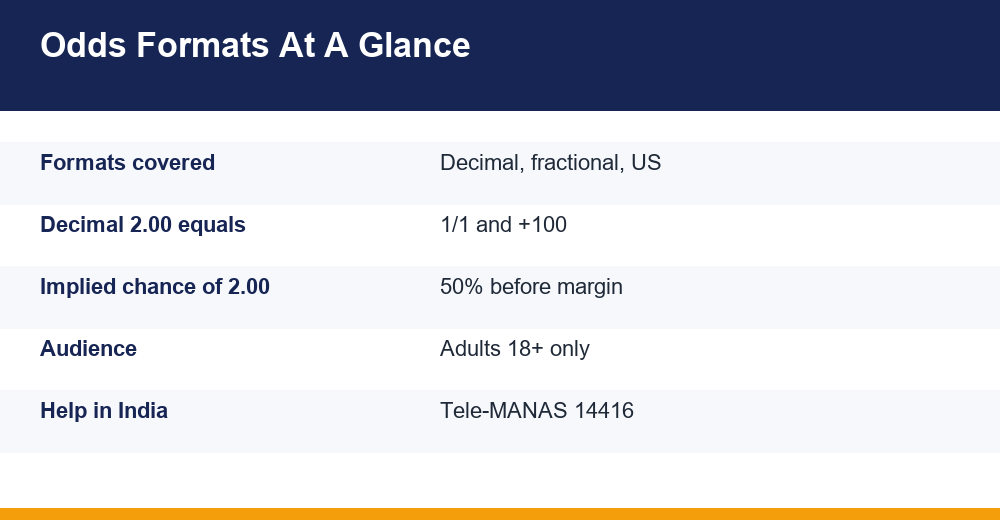
There are only three cricket betting odds formats in common use worldwide, and they are notation systems rather than different products. A price written as 2.00, as 1/1 and as +100 is one price in three handwritings. Nothing about a potential return changes when the display setting changes; only the symbols do.
Each format answers a slightly different question. Decimal answers what comes back in total for every rupee staked. Fractional answers what profit is made relative to the amount put in. American answers how the price compares with a round stake of 100 units.
Being able to read all three matters because cricket coverage is global. A fixture discussed on an English county page may be quoted in fractions, an Australian preview in decimals and a North American roundup in moneyline. Mistaking one notation for another can leave you misjudging a price by a wide margin.
- Decimal: total return per unit staked, with the stake included
- Fractional: profit relative to stake, written as a fraction
- American: profit on 100 staked (plus) or stake needed to win 100 (minus)
- All three convert exactly into one another, with rounding the only loss
Reading a price is a small literacy skill, and it is the one part of this subject that is genuinely useful. The arithmetic is fixed, publicly checkable and identical on every platform, so it is the single area where a reader can be sure nobody is bluffing them with a number.
One point applies to every format on this page: betting outcomes are chance events, real money is at risk, and prices are constructed to favour the operator over time. Nothing here is encouragement to place a bet, and everything below is written for adults aged 18 and over.
What Decimal Odds Mean
Decimal odds show the total return on a winning stake, with your own money included. If a price reads 1.80 and the stake is 100, a winning result returns 180: the 100 stake back plus 80 profit. The decimal number is a multiplier, nothing more.
Because the stake is baked in, decimal odds never drop below 1.00. A figure of 1.01 describes a very heavy favourite returning one unit of profit per hundred staked. A figure of 15.00 describes an outcome the market treats as unlikely.
Reading decimal prices quickly
- Multiply the stake by the decimal to get the total return.
- Subtract the stake to see the profit on its own.
- Anything under 2.00 means profit smaller than the stake.
- Anything over 2.00 means profit larger than the stake.
Decimal also makes rounding visible. A raw price of 1.833 shown as 1.83 costs a fraction of a unit per hundred staked, which is small on small stakes and easy to verify: multiply, then subtract. Rounding in fractions is harder to spot because the steps between traditional fractions are uneven.
That clarity is why decimal has become the default in most apps and on most data feeds. There is no need to compare 4/5 against 8/11 in your head, because 1.80 and 1.73 sort themselves into order. The same multiplier logic is useful when checking how a promotional balance behaves, a separate subject covered in our breakdown of common cricket betting bonus types and their wagering conditions.
Fractional Odds And Converting Them To Decimal
Fractional odds are the older British notation and remain traditional in cricket, football and horse racing coverage. They show profit relative to stake. A price of 5/4 means four units staked returns five units of profit, so 400 staked wins 500 profit and returns 900 in total.
The conversion to decimal is one line of arithmetic: divide the top number by the bottom number, then add 1. So 5/4 becomes 1.25 + 1 = 2.25, and 1/2 becomes 0.5 + 1 = 1.50. Going the other way, subtract 1 from the decimal and express the remainder as a fraction, so 5.00 becomes 4/1.
Odds-on, odds-against and evens
- Odds-against: numerator larger, such as 3/1. Profit beats the stake. Decimal above 2.00.
- Evens, written 1/1: profit equals stake. Decimal exactly 2.00.
- Odds-on: denominator larger, such as 2/5. Profit smaller than the stake. Decimal below 2.00.
- Fractions are often left unreduced, so 6/4 appears rather than 3/2. The value is identical.
The catch with fractions is precision. Many live prices do not land on tidy fractions, so operators round to the nearest step on a traditional ladder of 1/2, 8/15, 4/7, 8/13 and so on. Convert a rounded fraction back to decimal and the result can sit a point or two away from the raw price. Where exactness matters, read the decimal.
Spoken fractional prices carry their own shorthand, and it trips people up. “Five to four on” means the odds-on version, 4/5, while “five to four against” means 5/4. Those two are not close: 1.80 versus 2.25. If a quote is spoken rather than written, convert it before accepting it as read.
American Odds: What +200 And -150 Actually Mean
American odds, also called moneyline, use a base stake of 100 and a sign. A plus number tells you the profit on a 100 stake. A minus number tells you the stake required to win 100 in profit. The sign is the whole trick.
So +200 means 100 staked wins 200 profit, returning 300 in total. In decimal that is 200 divided by 100, plus 1, which is 3.00. In fractions it is 2/1. Meanwhile -150 means staking 150 to win 100, which converts to 100 divided by 150, plus 1, or roughly 1.67 decimal and 2/3 fractional.
The 100 is a reference unit, not a minimum stake. The same ratio applies to any amount: at +200, a 250 stake wins 500 in profit. The format simply states how a favourite or an underdog is priced against a round number.
The two conversion formulas worth memorising
- Positive American to decimal: (number divided by 100) + 1. So +450 becomes 5.50.
- Negative American to decimal: (100 divided by the number, ignoring the sign) + 1. So -250 becomes 1.40.
- Decimal above 2.00 to American: (decimal minus 1) multiplied by 100, shown as a plus figure.
- Decimal below 2.00 to American: minus 100 divided by (decimal minus 1), shown as a minus figure.
Note that +100 and -100 describe the same thing: evens, or 2.00 decimal. Most operators display that price as +100 rather than -100 by convention, so seeing one and not the other is normal.
The notation exists because North American markets quote most contests as two-sided prices with a favourite and an underdog, and a signed number conveys that split instantly. It is less convenient for long prices, since +4900 and +9900 are far harder to compare at a glance than 50.00 and 100.00.
Side-By-Side Conversion Breakdown
Setting the three cricket betting odds formats next to each other makes the relationships obvious. The implied probability column is the raw figure derived from the price, calculated as 1 divided by the decimal odds and expressed as a percentage. The rows below are rounded illustrative examples, not prices taken from any operator.
| Fractional | Decimal | American | Raw implied chance | Profit on 1,000 stake |
|---|---|---|---|---|
| 1/5 | 1.20 | -500 | 83.3% | 200 |
| 1/2 | 1.50 | -200 | 66.7% | 500 |
| 4/5 | 1.80 | -125 | 55.6% | 800 |
| 1/1 | 2.00 | +100 | 50.0% | 1,000 |
| 6/4 | 2.50 | +150 | 40.0% | 1,500 |
| 2/1 | 3.00 | +200 | 33.3% | 2,000 |
| 4/1 | 5.00 | +400 | 20.0% | 4,000 |
| 9/1 | 10.00 | +900 | 10.0% | 9,000 |
Two habits follow from the table. First, 2.00 is the hinge: above it the fraction is odds-against and the American figure is positive, and below it the reverse holds. Second, the implied chance falls away quickly as the decimal rises, which is why long prices pay large multiples so rarely.
A third habit is worth building: never compare a fraction with a decimal by eye. The strings 8/13 and 1.80 look broadly similar on a page and are not close, because 8/13 is about 1.62. Convert first, compare second.
Also worth noting is that the profit column is gross profit on a settled winning bet, not money in hand. What eventually reaches a bank account depends on the account steps described in our walkthrough of the cricket betting withdrawal process, including verification and processing times.
Do Odds Show The Real Probability Of An Outcome?
No. The implied probability calculated from a price is an estimate with a commercial margin already added. Add up the implied probabilities of every outcome in a market and the total comes to more than 100%. That excess is called the overround, and it is the structural reason an operator profits across a large number of bets.
Take a simple two-way cricket market priced at 1.80 and 2.00. The implied chances are 55.6% and 50.0%, which sum to 105.6%. Reality cannot exceed 100%, so roughly five percentage points of that total is margin rather than any opinion about the match.
Turning the overround into a margin is not simply subtracting 100%. The standard calculation is 1 minus (1 divided by the overround total), which in this example gives about 5.3%. To estimate the market’s genuine view, divide each raw probability by the total: 55.6 divided by 105.6 gives about 52.6%, and 50.0 divided by 105.6 gives about 47.4%. Those normalised figures sum to 100%.
- Raw implied probability is always inflated by the margin.
- Normalising removes the margin but assumes it was spread evenly across outcomes.
- Margins are not necessarily spread evenly, so normalised figures stay approximate.
- Markets with many outcomes, such as top-batter lists, usually carry a wider overround than two-way markets.
The overround also explains why comparing two platforms on a single price tells you very little. A market can look generous on the favourite and carry its margin on the outsider instead. Summing every outcome in that market is the only way to see the whole figure rather than one corner of it.
The practical takeaway is worth stating plainly: the built-in margin means the arithmetic runs against the bettor over time, whichever notation appears on screen. Outcomes stay chance events and real money is genuinely at risk. Independent charity material on how gambling products are designed, such as the resources published by BeGambleAware, sets out the same point with no commercial interest in the answer.
Which Format Is Most Common In India?
Among cricket betting odds formats seen by Indian audiences, decimal is the one most people meet first, because it is the default display on the large majority of international apps and odds feeds. Published sources disagree on precise shares, and no reliable survey of Indian user preferences exists, so treat any specific percentage online as marketing rather than measurement.
What can be said with confidence is where each notation tends to surface.
| Where you see it | Typical format | Why |
|---|---|---|
| Most app defaults and odds feeds | Decimal | Easy to sort and display numerically |
| British and Irish cricket media | Fractional | Long-standing newspaper convention |
| North American sportsbook content | American | Moneyline is the local standard |
| Exchange-style interfaces | Decimal | Prices move in fine increments |
A separate notation sometimes appears in Indian cricket discussion: a spoken two-number style passed around informally, for example quotes framed as “95 paise” or “1.15 to 1.20”. These are not a standard format with a fixed definition, they vary between groups, and they usually leave no written record of what was agreed. Treat anything quoted outside a clear written decimal or fractional price as unverifiable.
Fractional notation also lingers in historical cricket writing, so an older match report quoting 7/2 is simply saying 4.50 in modern terms. Reading archive coverage is far easier once that conversion is automatic.
Format preference has no effect on cost. Switching a display to fractions does not shrink the margin, and no notation carries better value than another. Anyone claiming a particular format hides better prices is describing a sales pitch rather than arithmetic.
Changing The Display Format In An App
Most platforms allow a switch between cricket betting odds formats, and the control is usually a small settings item rather than something advertised. The switch is cosmetic: it changes nothing about a stake, a return or any bet already placed.
Where the setting normally lives
- Open the account, profile or settings menu.
- Look for an entry named “Odds format”, “Odds display” or “Preferences”.
- Pick decimal, fractional or American from the list offered.
- Confirm, then check a price you already know to be sure the change applied.
Some interfaces instead place the toggle at the top of the sportsbook page or inside a regional and language section. Not every platform offers all three options, and a few offer decimal only. If the setting cannot be found, the display is probably fixed for that market.
A word of caution: a display preference is only worth adjusting inside an app installed from an official source. Fake cricket apps circulate widely, often distributed as direct download files through messaging groups, and they imitate legitimate interfaces closely. A settings screen that asks for card details, a full banking password or remote-access permission in order to change an odds display is a serious red flag, not a normal step.
Two further checks take a moment. Confirm the change by looking at a price whose value you remember, since some apps apply the preference only after a refresh. And treat any screen demanding more than a preference, during what should be a one-tap change, as a reason to close the app rather than continue through it.
Anyone who believes they have been defrauded through a fake app or a payment request in India can use the national cyber fraud helpline on 1930, and reports can be filed through the official cybercrime portal at cybercrime.gov.in.
Red Flags, Margins And Personal Limits
Once all three cricket betting odds formats read fluently, a second skill matters more: recognising when a number is being used to mislead. The arithmetic itself is neutral, but it is routinely dressed up by people selling something.
- “Guaranteed” or “sure” odds: no price can guarantee an outcome, so any claim of certainty is false by definition, because a priced event is uncertain.
- Accounts showing only winning slips. Screenshots are trivially fabricated and losing bets simply go unposted.
- Prices far out of line with every other market for the same fixture, which usually signals a fabricated or non-functional product.
- Pressure to act within seconds. Urgency is a sales technique, not information.
- Any request to pay an individual’s personal account to “unlock” better odds or release a balance.
No odds format, conversion method or staking pattern changes the overround. A system promising to beat the margin by combining prices, chasing losses or doubling stakes is making a mathematical claim that does not hold, and its usual effect is faster losses rather than slower ones.
Because the margin runs one way, the only variable genuinely under a reader’s control is exposure. Deciding in advance what an affordable loss looks like, and treating it as money already spent rather than an investment, is the approach described in our notes on cricket betting bankroll management.
If it stops feeling like entertainment
Chasing losses, hiding activity from family, borrowing to continue or feeling unable to stop are recognised warning signs rather than character flaws. Free, confidential support exists in India through the government’s Tele-MANAS helpline on 14416, available around the clock in multiple languages. Outside India, organisations such as GamCare and the National Council on Problem Gambling run their own helplines.
Odds notation is worth learning so that nobody can bluff you with a number. Everything beyond that, the margin, the chance and the risk to real money, stays exactly as it was before you learned to convert 2/1 into 3.00.
Frequently Asked Questions
What do decimal odds mean in cricket betting?
Decimal odds show the total return per unit staked, including your own stake. At 1.90, a 100 stake returns 190: the 100 back plus 90 profit. Subtract the stake to see profit alone. Because the stake is included, decimal odds never fall below 1.00, and 2.00 marks the point where profit equals stake.
How do I convert fractional odds to decimal?
Divide the top number by the bottom number, then add 1. So 5/2 becomes 2.5 + 1 = 3.50, and 4/5 becomes 0.8 + 1 = 1.80. To reverse it, subtract 1 from the decimal and write the result as a fraction. Rounded traditional fractions can be slightly imprecise, so decimal is the more exact reading.
What does +200 mean in American odds?
It means a 100 stake wins 200 in profit, returning 300 in total. The plus sign marks an outcome priced as an underdog, with profit larger than the stake. It converts to 3.00 decimal and 2/1 fractional. A minus figure works the opposite way, so -200 means staking 200 to win 100 in profit.
Can I change the odds format in a betting app?
Most platforms allow it through an account, settings or preferences menu containing an entry such as “Odds format”. The change is purely cosmetic and does not alter stakes, returns or bets already placed. Some apps offer decimal only. Never enter banking passwords or grant remote access in response to a prompt during a display change.