Learning how to stop chasing losses matters more than any other habit for anyone who bets on cricket or plays colour-prediction rounds, because chasing is what turns a bad hour into a serious hole. Chasing is not a strategy error; it is an emotional reflex, and reflexes respond to rules set in advance rather than willpower in the moment. This article explains the psychology in plain language, then lays out stop rules, friction and support options that still work when a session goes wrong.
What Chasing Losses Means in Betting
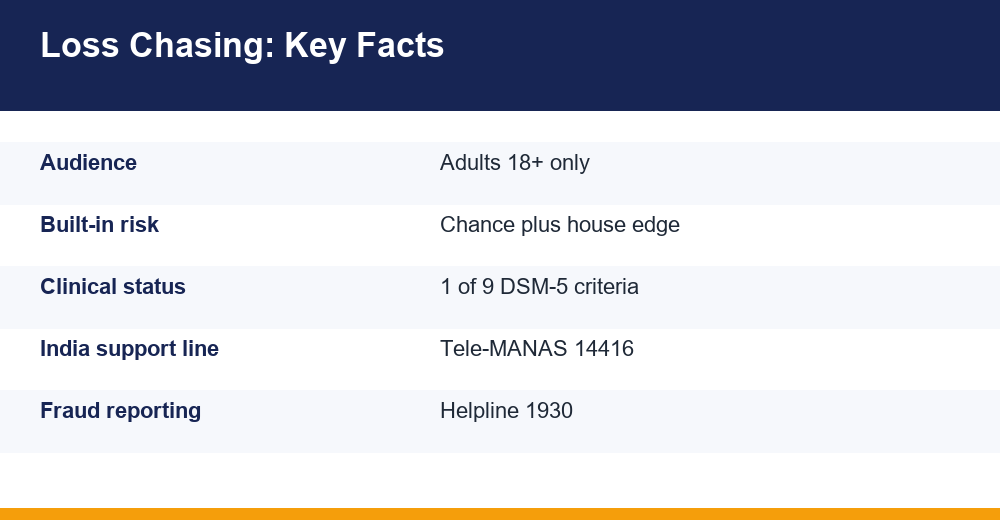
Chasing losses means staking money with the goal of getting back money you have already lost, rather than for the entertainment you originally signed up for. The clinical description used in the DSM-5 is blunt about the pattern: after losing money gambling, a person often returns another day to get even, and the urge to undo a loss pushes them towards larger stakes or greater risks.
The giveaway is not the size of the stake. It is the reason behind it. A planned stake of a given size is routine; the identical amount placed because the last one lost is a chase. That shift in motive is the whole problem, which is why how to stop chasing losses is better framed as a question about rules than about discipline.
It shows up in two shapes. Within-session chasing happens in minutes: stakes climb, research goes out of the window, and the plan you opened with quietly stops existing. Across-day chasing is quieter and often costlier, because the deposit arrives the next morning with a story attached to it.
- Topping up an account during or straight after a losing run
- Raising stake size specifically to win it back in one go
- Betting a match or market you know nothing about because it is simply the next one available
- Staying logged in past the time you told yourself you would stop
- Keeping a running mental tally of what you are down and treating it as a debt to be recovered
- Hiding the session from people who would normally hear about it
One thing worth saying plainly before the steps below: these are games of chance with a built-in house edge, real money is at risk every round, and they are for adults aged 18 and over only.
Why Do People Chase Losses?
People chase because losses hurt disproportionately. Behavioural research on loss aversion consistently finds that the sting of losing a given amount is felt more strongly than the pleasure of winning the same amount. The brain treats a loss as damage that needs repairing, and the fastest-looking repair is the same button that caused it.
Sunk-cost thinking adds a second layer. Money already spent feels like an investment rather than a cost, so walking away feels like locking in failure. Two hours in and well down, quitting feels like a decision you have to justify, while continuing feels like no decision at all.
The due-for-a-win fallacy
The most expensive belief in this whole area is that a bad run makes a good result more likely. For products designed as independent chance events, including colour and number prediction rounds, each result carries no memory of the last one. Five reds in a row do not load the sixth round in your favour, and no sequence-reading method changes that, as the reality behind prediction tricks and pattern systems makes clear.
Cricket markets are not pure coin flips, but the trap wears the same costume: after four losing markets, the fifth supposedly has to land. The only thing that actually changed is your emotional state.
Near misses and partial results
Outcomes that almost landed are sticky. A wicket that fell one ball after your market closed reads as evidence you were close, not that you lost. Near misses sustain the sense of an imminent turnaround, and that sense is exactly what keeps a session alive past the point you meant to end it.
What Is Tilt in Gambling?
Tilt is a term borrowed from poker. It describes the state where frustration, anger or urgency takes over decision-making, so a person plays in a way they would never endorse when calm. Tilt is not a strategy failure; it is a temporary drop in judgement, and it is the engine room of most chasing.
The practical value of naming it is that tilt has physical symptoms you can catch before the next stake. Much of how to stop chasing losses comes down to spotting these signals early enough to act on a rule you wrote earlier, while you still can.
- Heart rate up, jaw or shoulders tight, breathing shallow
- Talking to the screen, or arguing with the result
- A narrowed feeling where only the next round seems to matter
- Irritation at interruptions, including messages from family
- Loss of time awareness, and surprise at the actual clock
- A sense of unfairness, as though a result was owed to you
Tilt passes, usually within twenty to ninety minutes of stopping. That is why a short mandatory gap beats a promise to be more careful: the gap does the work willpower cannot do mid-session. A walk, a meal or a shower all work better than sitting beside a closed tab.
How to Stop Chasing Losses: Seven Steps
Every step below shares one principle: the decision is made while you are calm and enforced while you are not. Rules you can overturn in the moment are not rules, they are intentions, and intentions lose to tilt every time.
- Write a session budget before you open anything. One number, treated as an entry fee for entertainment rather than working capital. Writing it down makes quiet revision harder.
- Set a loss cap and a win cap. The loss cap ends the session; the win cap stops a good run being handed straight back. Both need a number, not a feeling.
- Use a hard time limit with an external alarm. A phone timer that sits outside the app you are using is harder to dismiss than an internal intention to finish just one more over.
- Add friction to money movement. Remove saved cards and wallet shortcuts so a top-up takes deliberate minutes, not two taps. Many banks also offer a gambling payment block.
- Use the account tools rather than relying on memory. Platform-side deposit, loss and time limits work because they apply at the moment you are least able to apply them yourself.
- Never deposit during or immediately after a loss. Make it flat: no top-up on the same day as a losing session, full stop. This single rule removes the bulk of chasing damage.
- Replace the habit, do not just remove it. A planned alternative for the half hour after a loss gives the urge somewhere to go. A vacuum gets filled by the app.
Steps one and two sit on top of staking structure, so they are far easier to hold if your stake sizes already follow a plan. If that part is loose, start with cricket betting bankroll management and come back to the stop rules afterwards.
The table below pairs the most common chasing triggers with a rule you can pre-commit to. Figures are illustrative only and are not a recommendation about how much anyone should stake.
| Trigger | What chasing looks like | Pre-committed rule |
|---|---|---|
| Three losing markets in a row | Stake doubled to get level | Session ends at the third consecutive loss |
| Loss cap reached | Cap mentally revised upwards | Log out; no reopening until the next calendar day |
| Account balance hits zero | Immediate top-up | No deposit on a losing day, no exceptions |
| Big result almost landed | One more, I was so close | Near miss counts as a loss, not as progress |
| Late-night session drifting on | Time limit forgotten | External alarm; device goes in another room |
| Urge returns the next morning | Deposit with a story attached | Twenty-four-hour wait before any new funding |
| Borrowed money in play | Stakes funded from elsewhere | Session cancelled; talk to someone that day |
Pairing these with platform-side controls is what makes them stick. The practicalities of setting caps, cooling-off periods and time-outs are covered in more detail under deposit and loss limits.
Does a Stop-Loss Rule Really Help?
It helps, but only under conditions. A stop-loss rule you can lift with one tap is decoration. A stop-loss rule with a delay built into any increase is a genuine brake, because the delay outlasts the urge. This is also why platform limit increases are commonly subject to a waiting period rather than taking effect at once.
The honest answer to how to stop chasing losses with a cap is narrow: it stops a bad session becoming a catastrophic one. Caps do not improve results, reduce the house edge or make outcomes predictable. Anyone selling a stop-loss as part of a winning system is selling something else entirely.
- Set the cap in money, not in rounds or overs
- Choose a number you would be relaxed about losing entirely
- Make any increase slow and any decrease instant
- Review the cap monthly when calm, never mid-session
- Tell one person the number, so someone else knows what the rule is
If you have set a cap three or four times and broken it each time, the cap is not the issue. Repeated failure to hold a self-set limit points towards the break tools and support below, not towards a tighter number.
Is Chasing Losses a Sign of a Gambling Problem?
It can be. Chasing is one of the nine criteria used to describe gambling disorder in the DSM-5, where a diagnosis involves four or more criteria occurring within the same twelve-month period, graded mild at four to five, moderate at six to seven and severe at eight to nine. One behaviour on its own is not a diagnosis, and nothing on a web page can give you one.
What chasing does reliably indicate is risk. It is the behaviour most closely tied to the financial damage people describe afterwards, because it converts an absorbable loss into one that is not.
- Borrowing, selling items or using household money to keep playing
- Hiding the amount lost, or lying about where the time went
- Restlessness or irritability when trying to cut down
- Needing larger stakes to feel the same interest
- Playing to escape stress or low mood rather than for enjoyment
- Betting affecting sleep, work, studies or relationships
If several of these look familiar, treat it as information rather than a verdict, and remember that how to stop chasing losses is a question of structure rather than character. Free and anonymous self-assessment questionnaires exist through non-commercial support organisations, and a short conversation with a trained listener is a lower-stakes step than most people expect. Details of one such service in India are in the final section.
Two patterns deserve particular attention because they escalate fastest: staking money that belongs to someone else, and funding play with borrowed money. Either one is worth treating as a stop signal on its own, regardless of how the numbers look.
How Do I Take a Break From Betting?
A break works best when it is arranged in layers, so no single moment of weakness can undo it. The sequence below moves from easiest to strongest, and in practice the first three on the same evening already change how the next few days feel.
- Request a time-out or cooling-off period on the account, typically available from twenty-four hours up to several weeks.
- Remove every saved payment method and delete autofill entries for the site from your browser and phone.
- Uninstall the apps and clear bookmarks, shortcuts and notification permissions. Notifications are a chasing trigger in their own right.
- Ask your bank or card issuer about a gambling transaction block, which many now offer and which usually takes a set period to reverse.
- Install a site or app blocker on every device you use, including a tablet or a work laptop.
- Tell one person you trust what you are doing. Accountability is unglamorous and unusually effective.
- If the urge keeps breaking through, ask about longer self-exclusion options and speak to a support service.
Expect the first three to five days to be hardest. The urge arrives in waves rather than as a steady pull, and most waves fade within roughly twenty minutes, which is long enough to lose a lot of money in without a plan.
What to do with the waves
Have two or three pre-decided actions for a wave and pick whichever is available: leave the house, call the person who knows about the break, or do something that occupies both hands. The aim is not to feel nothing. It is to put twenty minutes between the urge and a device.
Loss-Recovery Offers: Red Flags
People in a chasing cycle are a target market. Approaches offering fixed-match information, loss-recovery services, guaranteed prediction software or cloned apps tend to arrive quickly, and the pitch always maps neatly onto what someone chasing wants to hear.
Treat all of it as a red flag rather than making a judgement about any named platform or person. Describing the warning signs is more useful than accusations, and it leaves the decision with you.
- Any promise of guaranteed returns, assured recovery or a risk-free method
- An upfront fee, processing charge or tax demanded before a payout is released
- Requests for an OTP, UPI PIN, banking password or remote access to your phone
- Download links sent by message, or an app wanting contacts, SMS and gallery access for no plausible reason
- Payment to a personal account or wallet instead of a verifiable business channel
- Profit screenshots as the only proof, plus urgency about deciding today
- Support that exists only inside a chat app, with no traceable company details
If money has already gone, speed matters more than paperwork. In India, the cyber crime helpline 1930 operates around the clock alongside state police units and feeds the national cyber fraud reporting system, which can allow banks to act on funds still sitting in a recipient account. Follow the call with a detailed complaint on cybercrime.gov.in, keeping screenshots and transaction references ready. Never share an OTP or PIN with anyone, whoever they claim to be.
Where to Find Support
Asking for help is not a last resort, and it does not require a label. If betting is affecting your mood, sleep, finances or relationships, talking to someone trained is a reasonable next step at any stage, including well before anything feels serious.
In India, Tele-MANAS is a free, round-the-clock mental health helpline under the Ministry of Health and Family Welfare’s National Tele Mental Health Programme, with operations overseen by NIMHANS, Bengaluru. It can be reached on short code 14416 or toll-free on 1-800-89-14416, in a range of languages depending on the state, and service details are published at the official Tele-MANAS website.
- Tele-MANAS, 14416 or 1-800-89-14416, free and available 24×7 across India
- Your own doctor, who can refer you to counselling locally
- A trusted family member or friend, especially for help holding a money rule
- A debt or credit counselling service if borrowing has become part of the pattern
- Platform-side self-exclusion and limit tools, used alongside the above rather than instead of them
One last framing. Working out how to stop chasing losses is not about becoming a better bettor; it is about refusing to let a product with a permanent mathematical edge decide the size of your losses. Outcomes are chance, the money at risk is real, and this is for adults aged 18 and over. Your limits are the one part of the arrangement genuinely yours to set.
Frequently Asked Questions
What does chasing losses mean in betting?
Chasing losses means staking money in order to win back money you have already lost, rather than for entertainment. The stake size matters less than the motive: an amount placed because the previous one lost is a chase. It is listed among the DSM-5 criteria for gambling disorder, usually described as returning another day to get even.
Why do people chase losses?
Mainly because of loss aversion: the pain of losing an amount is felt more sharply than the pleasure of winning the same amount, so the brain treats a loss as damage to repair. Sunk-cost thinking makes stopping feel like accepting failure, and near misses create a false sense of being close to a turnaround.
What is tilt in gambling?
Tilt is a poker term for the state where frustration or urgency overrides judgement, so someone plays in a way they would reject when calm. Physical signs include a raised heart rate, tight shoulders, irritation at interruptions and losing track of time. Tilt is temporary and usually fades within an hour or so of stopping.
Does a stop-loss rule really help?
Yes, provided it cannot be lifted instantly. A cap with a built-in delay on any increase works, because the delay outlasts the urge, while a cap you can raise with one tap does nothing. Stop-loss rules limit how bad a session gets; they do not improve results or reduce the house edge.