Deposit and loss limits are the two account controls that decide how much money can reach your betting balance and how much of it can drain away before the site stops accepting action. Most coverage treats them as one checkbox, which hides the fact that they count completely different numbers and behave differently when you try to change them. This breakdown explains each limit type, how to pick amounts from a real monthly budget, and why a site lets you cut a cap in seconds but makes you wait to raise it.
What Deposit and Loss Limits Actually Do
Deposit and loss limits are ceilings you set yourself, inside your own account settings, before money is at stake. Once saved, the platform enforces them automatically. A blocked deposit or a paused account is not a punishment or a technical fault; it is the instruction you gave the system working as intended.
The reason both exist is simple. Betting outcomes are decided by chance and every market carries a built-in house edge, so no amount of research turns a long run of wagers into a reliable return. Real money is at risk on every single bet, which means the only variable you fully control is how much of it you expose.
Limits convert a vague intention into a hard stop. “I will not spend much this month” is a mood. A fixed sum the account cannot exceed in thirty days is an enforced rule that holds even when your judgement is poor.
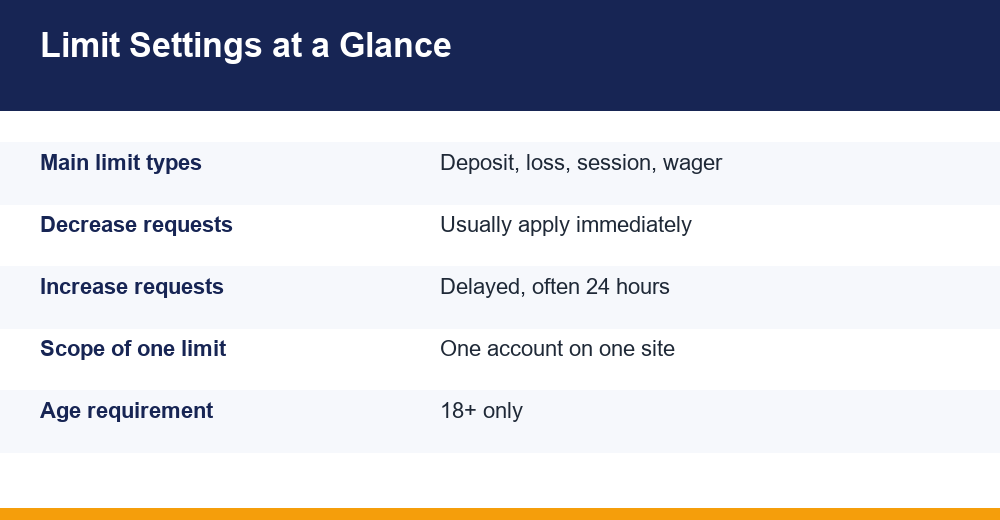
Across most platforms you will find four distinct controls, and it helps to know exactly what each one counts:
- Deposit limit, which caps money moving into the account over a chosen period
- Loss limit, which caps net losses over a chosen period regardless of deposits
- Session limit, which ends or warns you after a set length of continuous play
- Wager limit, which caps total stakes placed, win or lose, over a period
All four are free, and they are intended for adults aged 18 and over. Switching them on does not reduce the service you receive.
What Is a Deposit Limit on a Betting Site?
A deposit limit caps the total amount you can transfer into your account within a defined window, usually daily, weekly or monthly. Once you hit the ceiling, further payment attempts are declined until the window resets. It is the most widely offered control and usually the easiest to find in account settings.
The crucial detail most articles skip: a deposit limit watches money going in, not money going out. If you deposit a modest sum, win, and then lose those winnings alongside the original stake, your actual financial damage can exceed the limit several times over while the limit itself reports that you are within bounds.
How the window resets also matters. A rolling period counts the preceding seven or thirty days from right now, while a calendar period resets on a fixed date. The difference shows up at month end, when a calendar cap refreshes overnight and a rolling one does not. Check which model your account uses.
How bonus credit interacts with the cap
Promotional balances sit outside most deposit counters because they are not your deposits. That creates a false sense of safety: a careful cap does nothing to slow play funded by promotional credit, and the turnover conditions attached are often far larger than people expect. Reading the mechanics of cricket betting bonus types keeps those conditions from quietly undoing your limit.
To make a deposit cap represent real total exposure, pair it with a loss limit or a wager limit. Alone, it is a gate on the entrance rather than a measure of the room.
How to Set a Loss Limit Without Guesswork
A loss limit caps your net loss across a period. The platform tracks stakes placed against returns received; when the gap between them reaches your figure, betting is suspended for the remainder of the window. Because it measures the outcome rather than the input, it is the closer proxy for what the activity actually costs you.
Setting one is a short process on most sites, though the menu names differ. The sequence is broadly consistent:
- Open account settings and look for Responsible Gaming, Safer Gambling, Play Limits or a similar heading
- Choose the loss limit option rather than the deposit option, since they are listed separately
- Pick a period: daily, weekly or monthly, with monthly suiting a salary cycle
- Enter the figure you could lose without a single bill going unpaid
- Reopen the page after saving to confirm the limit shows as active with its end date
- Keep your own record of the confirmation, including the date you set it
Many platforms allow only one active loss limit per period type, so changing the figure replaces the existing one rather than stacking a second cap on top. Expect the new value to follow the change rules described further down.
The loss limit as a circuit breaker
The most useful property of a loss limit is that it fires when your thinking is least reliable: mid-losing-run, when the urge to recover the shortfall with a bigger stake is strongest. It removes the decision from you at that moment. If the pattern feels familiar, our piece on how to stop chasing losses explains why the urge persists and what interrupts it.
Deposit Limit vs Loss Limit: The Difference
People use the two terms interchangeably, and that is the most common and most expensive mistake in this area. They answer different questions. A deposit cap answers how much new money enters. A loss cap answers how much money disappears. Running only one leaves a visible gap.
| Feature | Deposit limit | Loss limit |
|---|---|---|
| What it counts | Funds transferred in | Stakes minus returns |
| Winnings re-staked | Not counted | Counted in the net figure |
| Bonus credit used | Usually not counted | Often counted as turnover |
| Trigger point | Next deposit is declined | Betting pauses for the period |
| Best at | Controlling top-ups | Controlling true cost |
| Common weakness | Recycled winnings slip past | Not offered on every site |
A worked illustration makes the gap concrete, and these figures are illustrative only. Suppose a monthly deposit cap is reached, the balance then doubles on an early result, and that larger balance is wagered away. Nothing further was deposited, so the deposit cap never objected, yet the month cost roughly twice what the cap appeared to authorise.
The conclusion is to treat deposit and loss limits as a pair. The deposit cap protects your bank account from repeated top-ups; the loss cap protects your balance from being recycled until it is gone. Where a site offers only one, know which blind spot you are carrying.
Session Time and Wager Caps: The Skipped Two
Money is not the only resource that drains. Session and wager controls sit alongside the financial caps and are routinely ignored, partly because they sit a level deeper in the settings menu.
A session limit measures continuous time logged in. Depending on the platform it either closes the session at the threshold or shows a reality check, an interrupt message stating how long you have been active and what the current net position is. The interrupt matters because fast, repeating markets compress the sense of elapsed time, and an hour frequently reads as twenty minutes.
A wager limit caps total stakes placed over a period, win or lose. It is the strictest of the four for anyone whose pattern is high turnover on small margins, since the counter rises on every bet rather than only on losing ones. Someone staking the same sum repeatedly can breach a wager cap while the loss cap barely moves.
- Session limits suit anyone who loses track of time during live in-play markets
- Reality checks are a lighter option when a hard cut-off feels excessive
- Wager limits suit high-frequency, low-stake patterns that other caps miss
- Cooling-off periods, offered separately, block deposits and betting for a fixed stretch
- A cooling-off period is distinct from a limit change and cannot usually be cancelled early
Layering two or three controls beats perfecting a single one, because each closes a different route back to the account. Time-based controls also catch the pattern where spend stays flat but the hours climb, which is the most easily dismissed warning sign.
How Much Should You Set Your Limits At?
Set the figure from your own budget, never from the number the interface puts in front of you. Limit-setting screens commonly pre-fill a suggested value or offer a menu of preset amounts, and those presets exist for convenience rather than as advice about what is sensible for you. Treat anything already in the box as a blank to be overwritten.
Work from the bottom up instead. Start with income, remove every committed cost, and only then ask what is genuinely left over:
- Total your monthly income after tax
- Subtract rent or EMI, utilities, food, transport, fees and insurance
- Subtract savings and any debt repayment, treating these as fixed rather than optional
- Whatever remains is discretionary money shared with every other leisure activity
- Allocate only a fraction of that remainder, then set your monthly loss limit at that figure
- Set the monthly deposit cap at the same figure or lower, never higher
One rule carries more weight than any formula: if the amount would be missed, it is too high. Money needed for a bill, a loan instalment, school fees or a family commitment is not discretionary. Borrowed money is never a valid basis for a limit, because the obligation to repay it survives the outcome of the bet.
Start lower than feels necessary. Decreases apply quickly and increases do not, so an over-cautious opening figure costs a short wait while an over-generous one costs real money. The same arithmetic underpins the staking discipline in cricket betting bankroll management, where the size of the pot sets the size of each stake.
Review the numbers quarterly, and review them downward when income falls. Treating deposit and loss limits as a fixed annual setting means they slowly stop matching the budget they were drawn from.
Why Cuts Apply Instantly and Rises Are Delayed
This asymmetry is the most useful thing to understand about limit mechanics, and it is almost never explained. Tightening a limit and loosening one are not symmetrical operations, and platforms treat them differently on purpose.
A decrease applies immediately. Lower your cap and the tighter figure is live before you leave the page. Nothing is gained by delaying a request that reduces exposure, so operators generally process it on the spot.
An increase is delayed. Requesting a higher cap typically starts a cooling-off period, commonly around 24 hours and longer on stricter platforms, after which you must return and actively confirm the change. If you never confirm, the request lapses and the old limit stands. On monthly caps, an increase may wait until the current period ends.
| Request | When it takes effect | Action needed later |
|---|---|---|
| Lower a limit | Immediately | None |
| Remove a limit | After a waiting period | Confirm after the wait |
| Raise a limit | After a waiting period | Confirm after the wait |
| Add a new limit | Usually immediately | None |
The design reason is behavioural. The impulse to raise a cap peaks in a narrow window: mid-session, mid-losing-run, with a result apparently just out of reach. A day’s delay places a night’s sleep between the impulse and the ability to act on it, and the urge often does not survive the gap.
Treat the wait as the feature, not the friction. If a site processes an increase instantly with no confirmation step, that says something about how seriously its stated controls are implemented.
Do Limits Apply Across All Betting Sites?
No. This is the second major gap in the way limits are usually described. A limit is stored on one account on one platform. It is not portable. It does not follow you, and no shared register applies it elsewhere on your behalf.
The consequence is direct. A monthly cap on one site has no effect on a second account opened somewhere else, and someone holding four accounts with the same figure on each has quadrupled the ceiling they believe they set. Deposit and loss limits only describe real exposure when the account count is one, or when every account carries a share of one written-down budget.
Two practical steps close the gap:
- Keep a short written list of every betting account you actually hold, including dormant ones
- Set matching limits on all of them, with the figures split from one total rather than repeated in full
- Close accounts you no longer use, rather than leaving them available as spare capacity
- Re-check the list after any period away, since forgotten accounts are the ones used impulsively
Cloned apps and copied brand names
There is a related awareness point. Unofficial apps distributed outside official app stores, often copying a known brand’s name, colours and logo, may show a limit-setting screen that saves nothing at all. The toggle moves, a confirmation appears, and no control is enforced, alongside the far larger risk of handing payment credentials to an unknown party. Nothing here says any named platform is fraudulent; these are red flags to weigh for yourself.
- An installer file shared over messaging apps rather than an official store listing
- Permission requests unrelated to the service, such as contacts, SMS or call logs
- A limits page that saves but never shows the active limit and its end date afterwards
- Payment instructions pointing to a personal account or a hand-typed UPI ID
- Support reachable only through a chat app, with no verifiable company details
If money has already been sent to something that looks like a cloned service, report it in India through the National Cyber Crime Reporting Portal at cybercrime.gov.in or the financial fraud helpline on 1930, and inform your bank immediately. Early reporting matters more than certainty about what happened.
Six Smart Ways to Stay in Control
Pulling the mechanics together, six habits do most of the work. None of them require any assumption about results, which is the point: the outcome of any bet is chance, and the only part you decide in advance is your exposure.
- Set the limits before the first deposit, not after a bad week, so the figure comes from your budget rather than from a mood
- Run a deposit cap and a loss cap together, since each covers the other’s blind spot
- Add a session or reality-check limit, because time drains before money does
- Start lower than feels necessary, since cuts are instant and rises are not
- Treat the cooling-off wait as a decision point; letting an increase request lapse is a common outcome
- Audit every account quarterly, since limits are per-site and forgotten accounts are unlimited ones
Watch for the signals that limits alone will not resolve: repeatedly requesting increases, opening a fresh account once a cap binds, hiding the activity from people close to you, or betting money committed elsewhere. Those are signs the tools have stopped being enough on their own.
Support exists and it is free. In India, Tele-MANAS runs a 24×7 mental health helpline on 14416, with language options and trained counsellors; the service is described on the health ministry’s Tele-MANAS portal. Elsewhere, GamCare and BeGambleAware in the UK and the National Council on Problem Gambling in the US offer confidential support.
Deposit and loss limits are not a system for improving results, because no such system exists where outcomes are random and the margin favours the house. They are a way of deciding, while calm, what a reasonable worst case looks like, and then making that decision binding. This content is informational only and intended for adults aged 18 and over.
Frequently Asked Questions
What is a deposit limit on a betting site?
A deposit limit is a self-imposed cap on how much money you can transfer into your account within a set period, usually daily, weekly or monthly. Once the ceiling is reached, further payment attempts are declined until the window resets. It restricts incoming funds only, so winnings you re-stake are not counted against it.
What is the difference between a deposit limit and a loss limit?
A deposit limit counts money entering the account. A loss limit counts net losses, meaning total stakes minus total returns across the period. The difference matters because winnings that get re-staked and lost never register against a deposit cap, so a deposit-only limit can understate what a month actually cost you.
Can I remove a deposit limit instantly?
Usually not. Removing or raising a limit normally triggers a cooling-off period, commonly around 24 hours, after which you must return and actively confirm the change. If you never confirm it, the request lapses and the original limit stays in force. Lowering a limit, by contrast, takes effect immediately with no waiting.
Do limits apply across all betting sites?
No. A limit is stored against one account on one platform and does not transfer anywhere else. Holding several accounts with the same figure on each multiplies your real ceiling rather than reinforcing it. Keep a written list of every account you hold and split one overall budget across them.